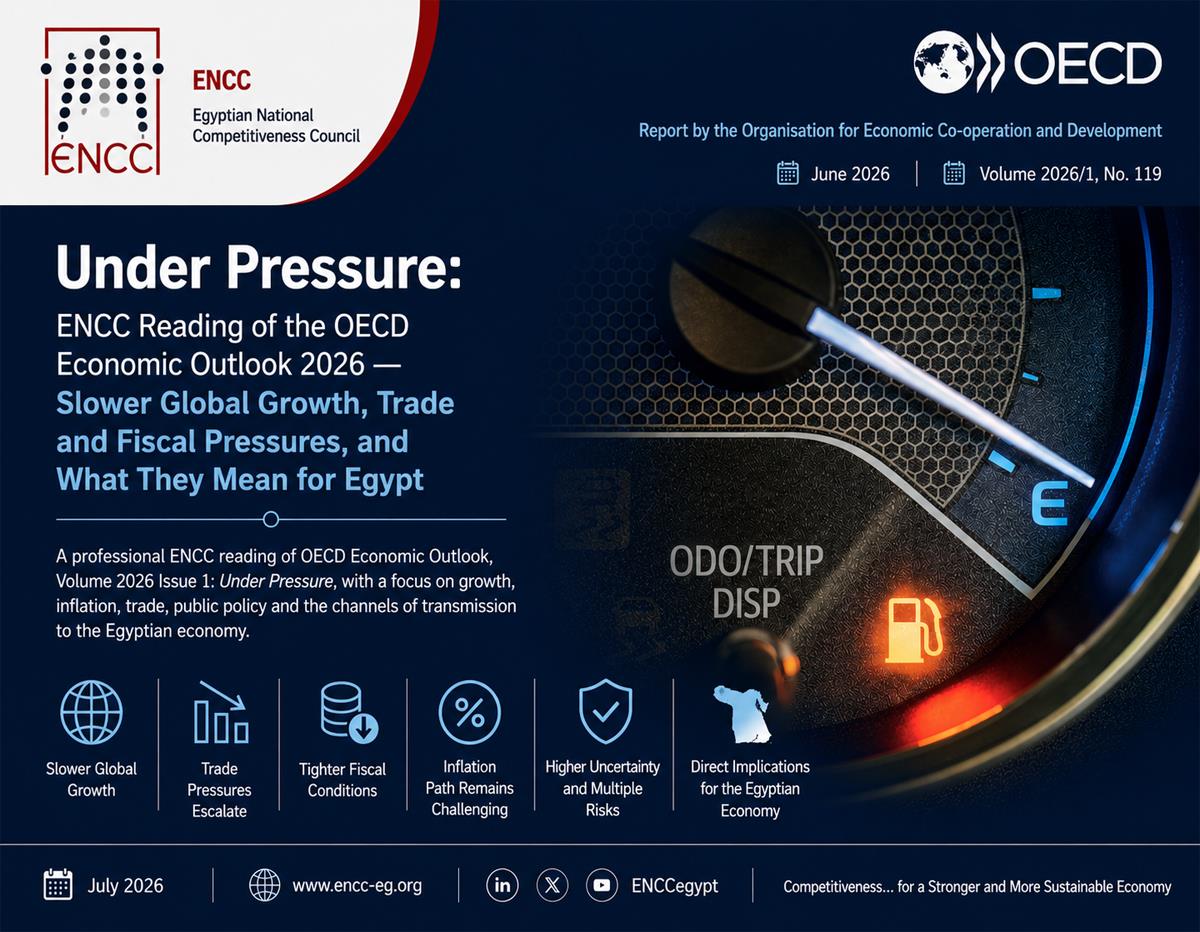
OECD Economic Outlook 2026 - Slower Growth, Trade and Fiscal Pressures, What They Mean for Egypt

Egyptian National Competitiveness Council (ENCC) | International Report Review
The Global Economy Under Pressure: ENCC’s Reading of the OECD Economic Outlook 2026 and What It Means for Egypt’s Competitiveness
Energy, food and financial shocks are redefining economic resilience, placing policy quality and structural reform at the centre of competitive capacity.
Report under review: OECD Economic Outlook, Volume 2026 Issue 1: Under Pressure — 3 June 2026.
The OECD Economic Outlook, Volume 2026 Issue 1, was released at a particularly complex moment for the global economy. After stronger-than-expected performance in 2025 and early 2026, developments in the Middle East conflict and disruptions to energy and shipping have become the dominant forces reshaping expectations for growth, inflation, investment and trade.
The report does not offer a single settled trajectory. Instead, it sets out two scenarios, depending on the duration and depth of the disruption. In both cases, its core message is that the shock does not stop at oil and gas prices: it reaches food, fertilisers, transport and industrial production, and then feeds through to purchasing power, public finances, credit markets and investment.
ENCC reads this release through a competitiveness lens. The economies most able to preserve stability and investment attractiveness are not necessarily those least exposed to shocks; they are those with credible macroeconomic frameworks, diversified and efficient energy systems, targeted protection instruments, well-supervised financial markets, resilient supply chains and a sustained capacity to implement growth-enhancing reforms.
I. Key Messages
- Global growth has entered a more fragile range: in the time-limited disruption scenario, growth declines from 3.4% in 2025 to 2.8% in 2026 before rising to 3.1% in 2027.
- A prolonged shock changes the outlook materially: under the prolonged disruption scenario, global growth falls to 2.1% in 2026 and 1.8% in 2027, with deeper effects on economies importing energy and food.
- Inflation creates a difficult monetary-policy trade-off: a temporary shock may allow room for patience if expectations remain anchored, but broader second-round effects could require tighter policy even as growth weakens.
- Broad energy support is not a durable solution: the report favours temporary, targeted and transparent measures that protect those most exposed without weakening efficiency incentives or creating permanent budget commitments.
- Resilience has become a competitive asset: energy diversification and efficiency, infrastructure quality, open trade and financial oversight determine the ability of firms and economies to operate under pressure.
- Structural reform cannot be deferred: higher productivity, stronger skills, competition, better regulation and innovation are what turn emergency response into sustainable growth capacity.
II. Report Profile and Methodology
| Official title | OECD Economic Outlook, Volume 2026 Issue 1: Under Pressure |
| Publishing institution | Organisation for Economic Co-operation and Development (OECD) |
| Publication date | 3 June 2026 |
| Type of release | Macroeconomic outlook, scenario analysis and policy recommendations; not a country index or ranking |
| Time horizon | 2025 estimates and projections for 2026–2027 |
| Egypt coverage | The report does not include an Egypt country note or standalone projections; subsequent Egypt-related content is ENCC’s policy reading of the potential implications for the Egyptian economy’s competitiveness |
The report includes an overall assessment of macroeconomic conditions, analysis of recent developments, risks and policies, a chapter on moving from energy shocks to stronger resilience, a chapter on the fiscal and economic effects of higher defence spending, and country notes for selected economies. It uses a scenario-based approach because the duration and scale of the conflict, as well as the path of supply and prices, remain unresolved.
III. A Global Economy Shaped by Shock Scenarios
The OECD finds that the global economy entered 2026 from a stronger starting point than expected, supported by AI-related investment, relatively improved financial conditions and an easing in some trade tensions. The Middle East conflict has nevertheless eroded an important part of that momentum through energy and input prices, confidence and financial markets.
| Indicator | 2025 | 2026 | 2027 |
|---|---|---|---|
| Global growth — time-limited disruption | 3.4% | 2.8% | 3.1% |
| Global growth — prolonged disruption | — | 2.1% | 1.8% |
| G20 inflation — time-limited disruption | 3.4% | 4.0% | 3.1% |
In the first scenario, disruption gradually eases and energy and trade routes begin to normalise from the second half of 2026. The prolonged-disruption scenario assumes that the shock continues into 2027, reducing growth, raising inflation and pushing a number of economies closer to recession. The figures should therefore be read not as a single unconditional forecast, but as two ranges that help governments and businesses stress-test their plans.
IV. How Does the Shock Reach the Real Economy?
1. Energy, Fertilisers and Food
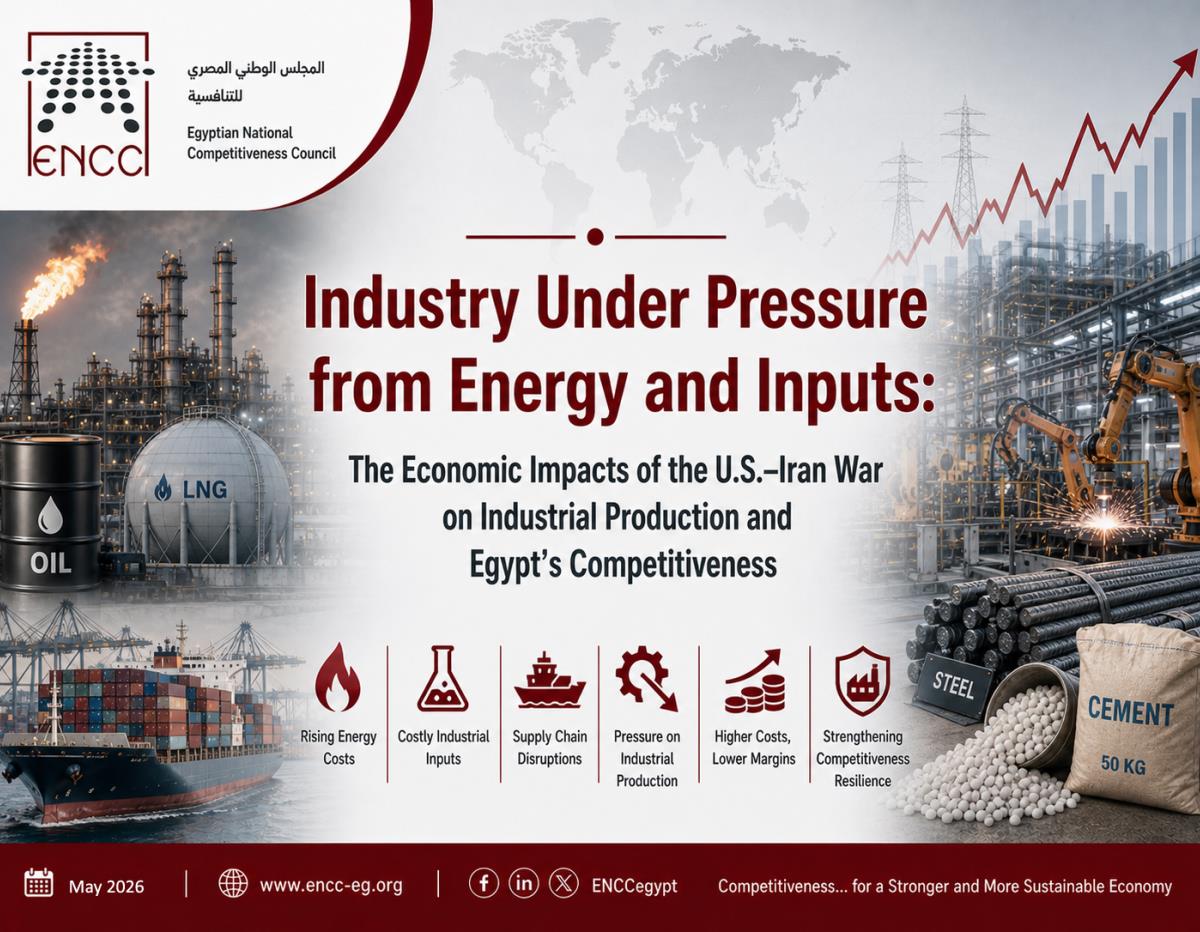
Disruptions affecting oil, gas and refined fuels raise the cost of transport, production and electricity. Higher gas and input prices then pass through to fertilisers, agricultural production and food. Energy-importing economies, low-income households and energy-intensive sectors are particularly exposed to this channel.
2. Inflation and Monetary Policy
Supply shocks place central banks in a difficult position. Rapid tightening can deepen the slowdown, while excessive accommodation can allow inflation expectations to become entrenched. The report calls for close assessment of the transmission of the shock into prices, wages and services, while preserving policy credibility and well-anchored expectations.
3. Public Finance and Social Protection
Governments face pressure to compensate households and businesses for higher prices, while debt levels and financing costs constrain fiscal space. Lessons from earlier energy shocks show that broad price support can be rapid, but is costly, poorly targeted and may weaken incentives to conserve energy.
4. Trade and Logistics
Geopolitical risk affects shipping and insurance costs, delivery times and the availability of critical inputs. The report also warns that export restrictions—particularly for food and essential inputs—can widen shortages and raise prices rather than sustainably protect markets.
5. Finance and Investment
Greater uncertainty, higher yields and lower risk appetite tighten financing conditions. The report highlights vulnerabilities associated with corporate debt, private credit, non-bank financial intermediaries and the possibility of elevated valuations in some AI-related assets.
V. From Emergency Response to Stronger Resilience
The OECD’s message extends beyond managing the immediate crisis to building institutional capacity that reduces the cost of future shocks. Effective protection starts before a crisis, with current data, accurate social registries, payment channels that can reach beneficiaries quickly, clear coordination across institutions and announced frameworks for withdrawing exceptional measures.
Over the medium term, energy resilience requires diversification, greater efficiency, stronger grids, storage and interconnection, improved demand response and investment that lowers energy intensity. These measures are inseparable from industrial and digital competitiveness: the reliability and cost of electricity have become key factors in investment decisions, including those involving data centres and AI infrastructure.
VI. What Does the Report Mean for Egypt? — ENCC Reading
The report does not provide standalone projections for the Egyptian economy and should not be presented as a direct assessment of Egypt. However, the shock-transmission channels it identifies are relevant to several issues that affect the competitiveness of the Egyptian economy. They provide a framework for testing policy readiness under two paths: gradual market normalisation, or sustained pressure on energy, inputs and finance.
| Area | Potential transmission channel | Competitiveness question for Egypt |
|---|---|---|
| Energy and industry | Fuel, electricity, transport and energy-intensive input costs | How can productive capacity be protected while preserving incentives for efficiency and investment? |
| Food and fertilisers | Gas, fertiliser and transport prices and their impact on food costs | How can inventories and alternative sources be managed while protecting the most exposed groups? |
| Public finance | Pressure on subsidies, social protection and debt service | How can support be temporary and precise without creating permanent obligations? |
| Trade and logistics | Shipping and insurance costs, route changes and delivery times | How can Egypt leverage its location and logistics services while reducing supply-chain exposure? |
| Finance and investment | Tighter global finance, volatile capital flows and higher risk premia | How can macroeconomic credibility, policy clarity and investor confidence be reinforced? |
| Digital economy | Data-centre and AI needs for reliable, competitively priced energy | How can energy policy be integrated with the digital-investment strategy? |
VII. Proposed Priorities for Egypt’s Competitiveness Under Pressure
- Establish an economic-resilience early-warning dashboard: consolidate indicators for energy, food, fertilisers, shipping, insurance, inflation and financing conditions, and issue a joint periodic update for relevant institutions.
- Move towards more targeted support: direct any emergency support to the most exposed households and viable enterprises, with a defined duration, transparent exit rules and regular review of the fiscal impact.
- Link energy policy to industrial competitiveness: identify energy-intensive sectors with the highest export value and prioritise energy efficiency, distributed generation, long-term contracts and grid investment.
- Strengthen food and fertiliser resilience: diversify suppliers, map exposure, improve inventory management and avoid trade restrictions that could amplify scarcity and cost.
- Develop macroeconomic and sectoral stress tests: assess the effects of energy, interest-rate, exchange-rate and shipping trajectories on firms, non-bank credit and supply chains.
- Align digital infrastructure with energy security: include electricity availability, cost, efficiency and source mix in assessments to attract data-centre and AI investment.
- Protect structural-reform momentum: continue improving competition, skills, regulatory quality, policy neutrality and trade facilitation so that crisis response does not become a permanent deferral of reform.
VIII. Suggested Monitoring Indicators
- Energy-import costs relative to exports and reserves.
- Shipping and insurance time and cost across major routes.
- Food and energy inflation and their pass-through to core inflation.
- Cost of emergency-support measures and the share of beneficiaries accurately targeted.
- Energy intensity in industrial and export-oriented sectors.
- Corporate refinancing exposure and changes in credit quality.
- Implementation rate of reforms related to productivity, competition, trade and skills.
ENCC Conclusion
The OECD Economic Outlook 2026 shows that resilience is no longer a defensive function separate from competitiveness; it has become one of its core components. Reliable energy, accurate social protection, disciplined public finance, open trade, sound financial systems, quality digital infrastructure and persistent productivity reform together determine an economy’s ability to absorb shocks without sacrificing investment, jobs or markets.
For Egypt, the priority is to use the report’s scenarios to test policy choices, rather than mechanically importing its projections. This requires combining the global context provided by the OECD with up-to-date official Egyptian data, then translating the results into anticipatory action and monitoring indicators. Competitiveness under pressure is built before the shock occurs: through institutions able to monitor, target, coordinate and adapt.
Limits of This Reading
- The report’s two scenarios are conditional on the path of the conflict, supply and prices; they do not constitute a single certain forecast.
- The report does not include an assessment, ranking or country projections for Egypt.
- The Egypt-related sections are ENCC’s policy reading and should be supplemented with current official Egyptian data when used for detailed decisions or quantitative estimates.
Official Source
OECD, OECD Economic Outlook, Volume 2026 Issue 1: Under Pressure, OECD Publishing, Paris, 3 June 2026.
© Egyptian National Competitiveness Council (ENCC) — 2026