

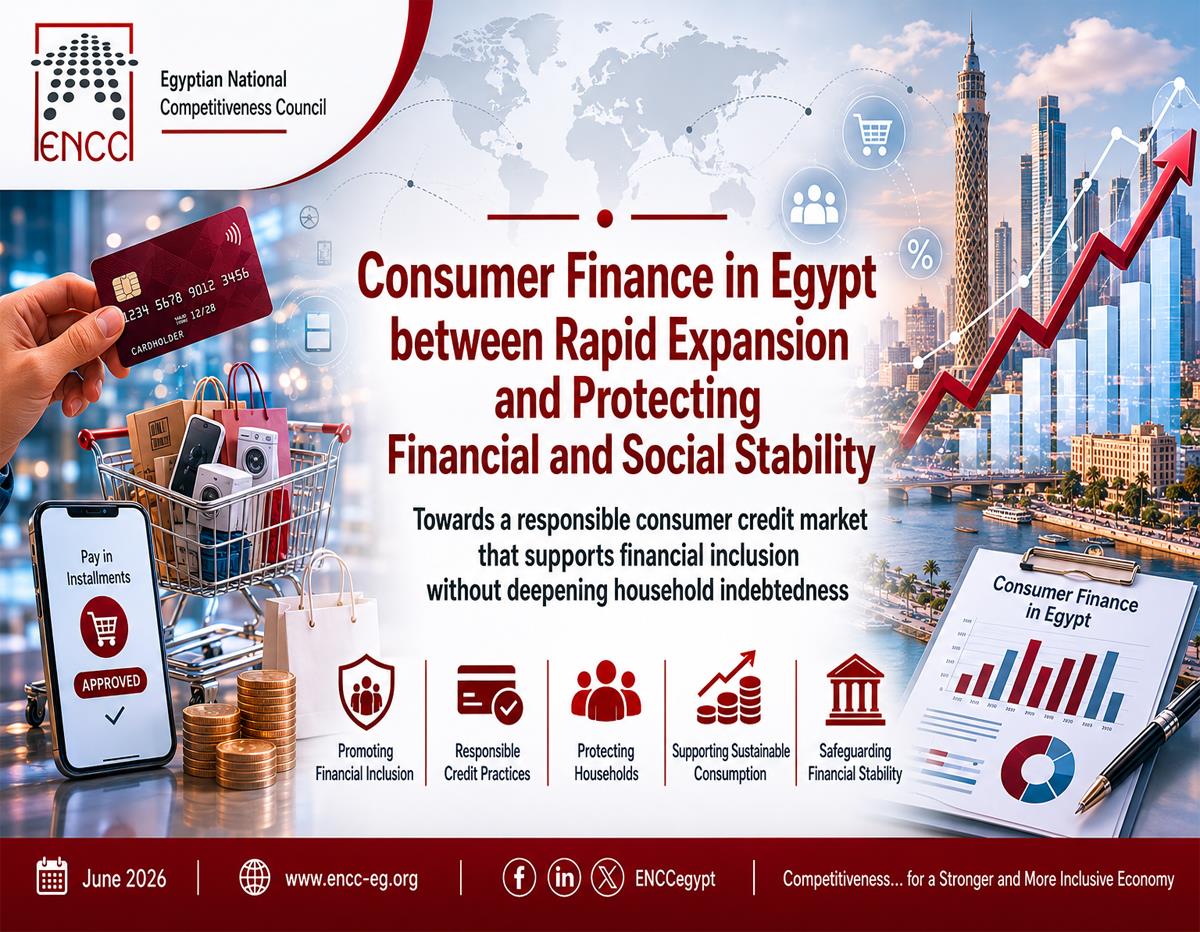
Consumer Finance in Egypt between Rapid Expansion and Protecting Financial and Social Stability
ENCC_Consumer_Finance_Egypt_Responsible_Credit_Report_EN_2026
Consumer Finance in Egypt between Rapid Expansion and Protecting Financial and Social Stability
Towards a responsible consumer credit market that supports financial inclusion without deepening household indebtedness
First: Executive Summary
Egypt’s consumer finance market has expanded rapidly in recent years, driven by the interaction of several factors: inflation and rising prices of goods and services, the erosion of household purchasing power, the growth of digital commerce, the wider use of financial-technology applications, and the development of the legal framework regulating consumer finance activity since the issuance of Law No. 18 of 2020.
This sector has contributed important gains to the economy and the market, including expanding financial inclusion, supporting retail sales, bringing wider segments of citizens into a formal financing system, and providing a relatively regulated alternative to informal merchant installment practices. At the same time, however, it has created growing risks, especially with the large increase in customer numbers and financing volumes, the expansion of “buy now, pay later” models, greater reliance on securitization and bank credit lines, and the possibility of overlap in individuals’ indebtedness across banks, non-bank finance companies, credit cards, and merchant installment schemes.
This paper follows the public debate that intensified after the statements of Mr. Hisham Ezz Al-Arab, Chief Executive Officer of Commercial International Bank, regarding the risks of uncontrolled expansion in non-bank finance and the debate those statements raised around “shadow banking”, creditworthiness practices, and the possibility of risk transmission from finance companies to the broader financial system. The paper argues that these statements did not create the issue from nothing; rather, they exposed a question that had already been embedded in the figures, regulation, and market: how can Egypt benefit from consumer finance as a tool for financial inclusion and market activation without allowing it to become a channel for accumulating household debt or a source of risk to financial stability?
The position of the Egyptian National Competitiveness Council starts from a balanced principle: consumer finance is not a risk in itself, nor is it a sufficient solution in itself. It is a legitimate and needed financial tool if it is governed by rules of disclosure, creditworthiness, consumer protection, debt-burden measurement, marketing oversight, and control of risk transmission to banks and investors. If rapid growth is left without integrated databases and proactive supervision, it may shift from a tool of financial inclusion into a source of social and financial fragility.
The paper recommends a gradual policy package that includes: creating a publicly announced quarterly monitoring dashboard for the consumer finance sector; applying real-time and unified credit inquiry; adopting a ceiling for debt burden to income; requiring companies to disclose the effective annual cost of financing; regulating sales incentives and commissions; monitoring securitization and stress tests; protecting vulnerable groups; and deeper supervisory coordination between the Financial Regulatory Authority, the Central Bank of Egypt, and the Consumer Protection Agency.
Second: Background to the Issue
Consumer finance in Egypt evolved from a traditional commercial practice based on direct installment arrangements between merchant and consumer into a regulated financial activity whose companies are supervised by the Financial Regulatory Authority. Law No. 18 of 2020 provided a clear framework for this activity, defining consumer finance as financing dedicated to the purchase of goods and services for consumer purposes, not financing for productive activity or a commercial project.
Over time, the scope of financed goods and services widened. The activity is no longer limited to cars, home appliances, and durable goods; it now extends to electronics, furniture, finishing works, health care, education, travel, fashion, and some forms of daily or semi-daily purchases. Channels also evolved from traditional branches to digital applications, points of sale, prepaid cards, and instant financing solutions.
This development came in a pressured economic context. Egyptian households faced successive waves of price increases and declining purchasing power. With cash purchases becoming difficult, installment payments became a tool for managing monthly income. At the same time, firms and merchants found consumer finance to be a tool for supporting sales and overcoming stagnation, while fintech companies saw an opportunity to build fast-growing business models.
But the speed of growth created a fundamental question: is consumer credit being expanded based on accurate assessment of customers’ repayment capacity, or are competition, commissions, and digital expansion pushing the market to grant financing faster than supervision and data can keep up?
Third: Why This Issue Matters for Competitiveness
The Egyptian National Competitiveness Council views consumer finance as a file that intersects with several dimensions of economic and social competitiveness:
1. Business and investment environment
The consumer finance sector has become part of the business environment for commerce, retail, and financial technology. Its stability and transparency affect investor confidence, company growth, and market efficiency.
2. Financial inclusion
The sector helps bring millions of citizens into formal or semi-formal financial services and creates credit histories for groups that were not previously served by banking channels.
3. Household stability and domestic demand
When used responsibly, consumer finance can enable households to acquire necessary goods and services. But when it exceeds repayment capacity, it turns into future pressure on household income and consumption.
4. Financial stability
Although consumer finance companies are non-bank entities, their links with banks through credit lines or securitization bonds make their risks transmissible to the wider financial system.
5. Equity and consumer protection
Lower-income groups and those with weaker financial awareness may be more exposed to contracts whose true cost or late-payment consequences they do not understand.
6. Digital transformation
The expansion of applications and digital platforms creates opportunities for scale and efficiency, but it requires fair algorithmic rules, data protection, and disclosure that consumers can understand.
Fourth: Reading Market Development
Available data point to a rapid rise in the volume of consumer finance and the number of customers. The activity moved from relatively limited levels in the first years after regulation into tens of billions of Egyptian pounds annually, with the beneficiary base expanding into millions of customers. Some reports show that total consumer finance in 2025 exceeded EGP 90 billion in some estimates, or came close to that level in others, with the number of beneficiaries exceeding ten million customers.
This growth carries two linked implications:
- A positive implication: the market succeeded in reaching broad segments and creating demand for formal financing tools.
- A supervisory implication: the speed of growth and the number of transactions may distribute risk across millions of small obligations, requiring analytical and supervisory capacity beyond merely tracking the total value of financing.
- If confirmed in detailed data, a lower average financing value per customer may indicate expansion toward smaller and more frequent financing. This pattern differs from financing a car or a major durable good, because it may reflect a shift toward using finance as a continuous tool for managing monthly consumption.
Fifth: Drivers of Growth
The paper argues that the growth of consumer finance in Egypt resulted from five main drivers:
1. Inflation and erosion of purchasing power
Rising prices made cash purchases difficult for broad segments, particularly in durable goods, electronics, furniture, education, and medical treatment. Consumer finance therefore became a tool for spreading the cost of purchase over months or years.
2. Changing consumer culture
Acceptance of installment payments increased as a normal purchasing pattern, especially among young people and users of digital applications. With repeated use, installments may shift from an exceptional decision into a permanent financial behavior.
3. Ease of digital access
Digital platforms offer faster approvals and a less complex experience than traditional bank loans. This expands access, but it may also reduce consumers’ perception of the seriousness of the financial obligation.
4. Merchants’ interest in driving sales
In an environment of rising prices, merchants need point-of-sale financing tools to maintain sales volumes. Consumer finance therefore became part of the sales model itself.
5. Availability of refinancing tools
Finance companies rely on borrowing from banks or securitizing their credit portfolios to generate new liquidity. This allows continued growth, but it transfers part of the risk to banks and investors.
Sixth: Public Debate and Hisham Ezz Al-Arab’s Statements
The statements of Mr. Hisham Ezz Al-Arab generated wide debate because they came from a prominent banking figure and because they framed the issue in terms of systemic risk rather than merely commercial competition. His message centered on several points:
1. Concern about individuals expanding borrowing from non-bank financial entities instead of banks.
2. Warning about the emergence of a parallel banking sector, or what is globally referred to as “shadow banking”.
3. Questioning whether some companies apply disciplined credit-assessment rules comparable to those used by banks.
4. Pointing to the possibility of granting financing based on limited data and without comprehensive assessment of the customer’s repayment capacity.
5. Warning that small and undisciplined practices could turn into a wider risk if linked to bank financing, securitization, or major growth in customer numbers.
The paper confirms that the importance of these statements does not lie in directing a general accusation at all consumer finance companies, but in reopening a public-policy question: how do we balance financial innovation with the protection of stability? And how do we ensure that the flexibility of the non-bank sector is not used as an entry point to bypass rules of creditworthiness and disclosure?
Seventh: Gains from the Consumer Finance Sector
It is important that the public debate does not turn into an absolutely negative stance toward consumer finance. The activity has achieved several gains:
1. Expanding financial inclusion
The sector brought wide segments into organized financial relationships, especially those who do not easily obtain traditional bank loans.
2. Supporting commerce and retail
Installments helped move sales of durable goods, electronics, furniture, and services during periods of declining purchasing power.
3. Formalization — regulating an activity that already existed
Before regulation, installment practices existed through merchants, checks, and trust receipts. The legal framework made it possible to move part of this activity into licensed and supervised channels.
4. Supporting digital transformation
The sector pushed toward the use of applications, digital contracts, electronic payments, and credit inquiries, all of which are necessary elements for modernizing the financial market.
5. Creating new credit data
If data are managed properly, this sector can help build credit records for new groups, supporting long-term financial inclusion.
Eighth: Main Risks
1. Risk of excessive household indebtedness
When an individual has multiple borrowing sources — bank, credit card, finance company, application, merchant installment — no single provider may see the full picture of the debt burden. The possible result is monthly obligations exceeding the household’s actual repayment capacity.
2. Risk of weak disclosure of the true cost
The customer may see a monthly installment that appears acceptable, but may not clearly see the effective annual cost that includes administrative fees, penalties, insurance, collection expenses, and price differences.
3. Risk of aggressive marketing
If sales representatives’ income is linked only to financing volume, without regard to portfolio quality and repayment discipline, incentives may arise to push customers toward financing that does not suit them.
4. Risk of securitization and risk transfer
Securitizing finance portfolios allows companies to obtain liquidity, but it transfers customer risk to bondholders, including banks and financial institutions. The sector should therefore not be viewed as isolated from the banking system.
5. Risk of financing current expenses
Financing durable goods differs from financing current consumer expenses. The closer financing moves toward daily or short-lived expenses, the higher the likelihood of accumulating debt without a corresponding asset.
6. Risk to vulnerable groups
Female heads of household, informal workers, young people, and people with unstable income may be more exposed to poorly calculated contracts, especially if financial literacy is weak or advertising is misleading.
7. Risk of a regulatory gap
The wider the gap between banking rules and rules for non-bank finance entities, the greater the likelihood that activity moves to the less strict channel, not necessarily because it is more efficient, but because it is less costly from a regulatory standpoint.
Ninth: ENCC Position
The Egyptian National Competitiveness Council believes consumer finance should be viewed as one of the tools for modernizing the financial market and supporting financial inclusion, not as a risk that must be stopped, nor as a substitute for income policy or social protection.
The Council adopts the following position:
1. Consumer finance is a legitimate and useful activity if it is responsible and regulated.
2. The current speed of growth requires proactive supervision, not waiting for a crisis to appear.
3. Consumer protection is not an obstacle to the market; it is a condition for its sustainability.
4. Financial inclusion does not mean expanding debt without assessment.
5. Digital innovation must be subject to principles of fairness, transparency, and data protection.
6. Securitization and bank financing of finance companies require supervisory coordination between the Financial Regulatory Authority and the Central Bank.
7. The objective is not to reduce credit, but to improve credit quality.
Accordingly, the Council calls for developing a national framework for responsible consumer credit, combining innovation, disclosure, creditworthiness, consumer protection, and integration of supervisory data.
Tenth: Governing Principles for Reform
The paper proposes adopting eight governing principles:
1. Principle of full visibility of indebtedness
No new consumer financing should be granted unless the financing provider can know the customer’s existing obligations, whether with banks, finance companies, credit cards, or other financing entities.
2. Principle of repayment capacity
The core criterion is not the value of the good or the customer’s desire, but the customer’s realistic ability to repay after accounting for basic needs and other obligations.
3. Principle of declared full cost
The customer must know the total amount to be paid, not only the monthly installment. The effective annual cost rate must be presented in a simplified form.
4. Principle of financial suitability of the product
A customer should not be offered a financing product that does not suit their income, spending pattern, or the period during which they benefit from the good or service.
5. Principle of incentive oversight
Commission systems should not reward quantitative growth only; they must be linked to repayment quality, reduction of default, and customer protection.
6. Principle of protecting vulnerable groups
The groups most exposed to risk need additional disclosure, awareness, and protection rules.
7. Principle of stress testing
Large companies with broad portfolios or significant securitization should conduct periodic stress tests on their portfolios.
8. Principle of supervisory coordination
The non-bank sector does not operate separately from banks. Supervision must therefore be integrated between the Financial Regulatory Authority, the Central Bank of Egypt, and the Consumer Protection Agency.
Eleventh: Policy Recommendations
Recommendation 1: Establish a national consumer finance data dashboard
A quarterly data dashboard should be published, including:
- Total value of financing.
- Number of customers.
- Average financing value per customer.
- Distribution by type of good or service.
- Geographic distribution.
- Default ratios.
- Rescheduling ratios.
- Complaints.
- Securitization volume.
- Cash-advance financing volume.
- Number of customers receiving financing from more than one provider.
Recommendation 2: Adopt a unified debt-to-income rule
The Council proposes setting a regulatory ceiling for debt burden to income, so that customer installments do not exceed a defined share of income, with measured flexibility for informal groups based on documented income-estimation models.
Recommendation 3: Require real-time credit inquiry
No consumer financing above a certain threshold should be granted without a real-time and updated credit inquiry. Financing data should also be updated quickly after disbursement to prevent customers from obtaining simultaneous financing from multiple providers without each provider knowing about the others.
Recommendation 4: Require disclosure of the effective annual cost
Before contracting, every company should show the consumer:
- Cash price of the good.
- Total amount after financing.
- Value of each installment.
- Number of installments.
- Administrative fees.
- Penalties.
- Early repayment cost.
- Effective annual cost rate.
Recommendation 5: Regulate marketing and advertising
Advertisements that present financing as “free” or “without cost” should be prohibited if there are fees, price differences, or penalties. Warning messages about late payment should be clear and simple.
Recommendation 6: Review commission and incentive systems
The paper recommends that the Authority review sales incentive rules within companies, so that commissions are not tied only to the volume of financing granted, but also to repayment quality and the absence of rising default.
Recommendation 7: Regulate securitization and stress tests
Companies issuing securitization bonds should be required to provide detailed disclosures on the quality of securitized portfolios, default ratios, the distribution of financed goods and services, and stress tests simulating higher default or lower income.
Recommendation 8: Special rules for cash-advance financing
The closer consumer financing gets to cash financing, the greater the need for controls similar to personal loans, particularly in relation to inquiry, debt burden, and financing purpose.
Recommendation 9: Protect vulnerable groups
The Council proposes designing financial-awareness programs targeted at the groups most exposed to risk, focusing on:
- Female heads of household.
- Young people.
- Irregular workers.
- Low-income households.
- First-time users of digital applications.
Recommendation 10: Establish a simplified and unified grievance mechanism
A unified and rapid channel should be established to receive consumer finance customer complaints and link them to supervisory indicators that reveal the companies or products with the highest complaint or dispute levels.
Twelfth: Proposed Implementation Matrix
| Term | Measure | Lead entity | Participating entities |
|---|---|---|---|
| 0–3 months | Prepare an initial quarterly data dashboard | Financial Regulatory Authority | Finance companies; Central Bank |
| 0–3 months | Draft a unified disclosure model for effective cost | Financial Regulatory Authority | Consumer Protection Agency |
| 3–6 months | Apply the debt-to-income rule | Financial Regulatory Authority | Central Bank; I-Score |
| 3–6 months | Review marketing and advertising rules | Consumer Protection Agency | Authority; companies |
| 6–12 months | Integrate credit inquiry data across channels | Central Bank and Authority | I-Score; companies |
| 6–12 months | Conduct stress tests for major companies | Financial Regulatory Authority | Companies; auditors |
| 12 months | Conduct a comprehensive regulatory impact assessment | Financial Regulatory Authority | Cabinet; Parliament; ENCC |
Thirteenth: What Should Not Happen?
The paper warns against three undesirable paths:
1. Choking the sector entirely
Stopping consumer finance or restricting it excessively could harm commerce and financial inclusion and push the activity back into less safe informal channels.
2. Leaving the market to grow without controls
Relying on competition alone, without rules for disclosure, inquiry, and debt-burden measurement, could lead to excessive indebtedness and loss of confidence.
3. Reducing the issue to a conflict between banks and finance companies
The issue is not competition between market actors, but a matter of financial stability, consumer protection, and market competitiveness.
Fourteenth: Research Questions Requiring Follow-Up
The Council proposes following up on the following questions at a later stage:
1. What share of customers receives financing from more than one provider?
2. What is the average monthly debt burden to income across different income segments?
3. What share of financing is directed to durable goods compared with financing current expenses?
4. What is the size of securitization linked to consumer finance portfolios?
5. What is the relationship between inflation and consumer finance growth?
6. Which groups are most exposed to default?
7. Do published default ratios reflect the full risks, or is rescheduling delaying recognition of default?
8. Does the consumer understand the true cost of financing before contracting?
9. What is the impact of consumer finance on household saving?
10. How can fintech be used to reduce risks rather than increase them?
Fifteenth: ENCC Message to Stakeholders
To the Financial Regulatory Authority
The recent regulatory steps are in the right direction, especially the temporary halt to expansion in traditional licenses, the review of solvency, and the handling of cash-out practices. What is now needed is a shift from license-based supervision to data- and risk-based supervision.
To the Central Bank of Egypt
Non-bank consumer finance should be viewed as indirectly related to banking stability because of credit lines and securitization. Coordination with the Authority is necessary to ensure full visibility of risks.
To consumer finance companies
Sustainable growth requires the sector to move from “customer growth” to “customer quality”. Customer protection is not a burden; it is an asset of market trust.
To banks
Financing companies or purchasing their securitization bonds must be tied to rigorous examination of portfolio quality, not merely the bond yield or the strength of the issuing company.
To Parliament
The legislative and oversight role should focus on consumer protection, disclosure, creditworthiness rules, and data integration, without closing the door to innovation.
To citizens
Installments are not additional income. They are future obligations that must be included in the household budget and should not be used to fill a permanent gap in current expenses except in the narrowest limits.
Sixteenth: Conclusion
Consumer finance in Egypt stands at a decisive moment. The sector has proven its ability to grow, reach customers, and affect the market, but at the same time it has revealed a clear need for deeper governance. The wider the customer base and the more diverse the products, the greater the importance of data-based supervision, simplified disclosure, and responsible credit assessment.
The Egyptian National Competitiveness Council believes the best path is neither to stop consumer finance nor to leave it to grow without controls, but to build a national framework for responsible consumer credit. This framework should protect citizens, support serious companies, maintain confidence in the financial sector, and ensure that financial inclusion becomes a path toward stability and opportunity, not toward unsustainable indebtedness.
Thus, the real question is not: do we need consumer finance? Rather, it is: how do we make it responsible, transparent, fair, and supportive of the competitiveness of the Egyptian economy and the quality of life of citizens?
Annex: Concise Position Statement
The Egyptian National Competitiveness Council calls for treating the rapid growth in consumer finance as both an opportunity and a source of risk. The sector supports financial inclusion, commerce, and digital transformation, but it needs stronger controls in creditworthiness, disclosure, consumer protection, debt-burden measurement, securitization monitoring, and integration of supervision among the relevant authorities. The objective is not to reduce financing, but to raise the quality of financing; and not to choke innovation, but to ensure that financial innovation works for the benefit of citizens and economic stability.