

Food Security Under Pressure: Economic Impacts of the U.S.–Iran War on Food and Fertilizers
ENCC_US_Iran_War_FoodSecurity_SectorReport_EN
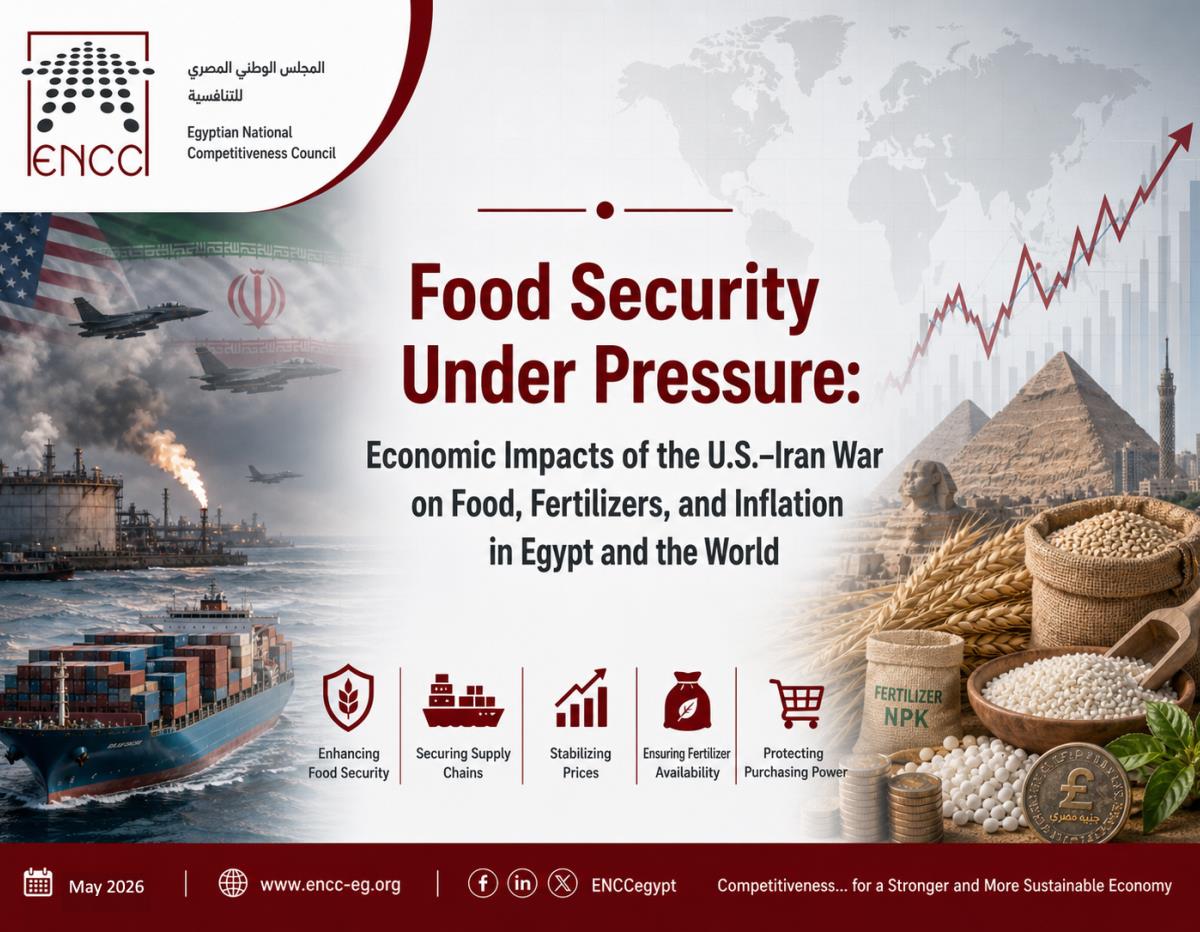
Food Security Under Pressure: Economic Impacts of the U.S.–Iran War on Food, Fertilizers, and Inflation in Egypt and the World
1. ENCC institutional opening note
1.1 Short opening note
The Egyptian National Competitiveness Council (ENCC) issues this sector report as the first sectoral report within the Council’s series on the economic impacts of the ongoing war between the United States and Iran. This release focuses on food security, as one of the most important channels through which the war’s impact transmits to the global, regional, and Egyptian economy—through energy, fertilizers, food prices, shipping, inflation, subsidies, and households’ purchasing power. The report is based on a dedicated, in-depth sectoral research pack for this topic.
2. Main title
Food security under pressure: the economic impacts of the U.S.–Iran war on food, fertilizers, and inflation in Egypt and the world
3. Subtitle
A sector report from the Egyptian National Competitiveness Council on the channels through which the war transmits into food, fertilizers, inflation, and Egypt’s food security
4. Executive summary
4.1 Executive summary
- The biggest risk to global food security is not only an immediate grain shortage. The research indicates global grain stocks remain at strong levels of about 951.5 million metric tons. The deeper risk lies in paralysis across energy and fertilizer markets and higher transport and insurance costs.
- Disruptions in the Strait of Hormuz, the Red Sea, and the Suez Canal created a double pressure on the food system: higher agricultural input costs on one hand, and higher cost of delivering food commodities on the other.
- Urea prices rose strongly worldwide; the research indicates average retail urea in the United States reached $858 per ton, up 41.1% versus pre‑conflict levels—raising the cost of producing fertilizer‑intensive crops.
- War‑risk insurance premiums jumped from peace‑time levels around 0.02% to ranges that may reach 1% to 10% of vessel value in extreme cases—raising the final landed price of food and imported agricultural inputs.
- For Egypt, food security is a direct sovereign channel because Egypt needs about 20 million tons of wheat annually, while the research expects wheat imports of about 12.5 million tons in the 2026/2027 season despite expected higher domestic production.
- The Egyptian government targets procurement of 5 million tons of local wheat in the 2026 season, at a procurement price of EGP 2,500 per ardeb, as a key absorption tool against global market volatility.
- Food subsidies in the FY 2026/2027 draft budget increased to about EGP 200 billion, including about EGP 130 billion for subsidized baladi bread—showing direct transmission of the global shock into public finances.
- Although Egypt has strong urea production capacity at about 7.2–7.3 million tons per year, gas and energy constraints may affect domestic fertilizer production—pressuring farmers and agricultural output.
- The food shock in Egypt is not merely a price shock; it is a shock that affects households, the budget, agriculture, food industries, the private sector, and the competitiveness of Egypt’s food system.
5. Why food security matters in this war
5.1 Food as an economic channel, not only a humanitarian one
In this war, food security is not only a humanitarian or social file; it is a macroeconomic channel. Higher food costs pressure inflation, reduce purchasing power, impose additional burdens on the public budget, and affect social and economic productivity—especially in food‑importing economies.
5.2 The energy–fertilizer–food link
Modern food systems are deeply linked to energy. Oil and gas enter farming equipment operation, irrigation, transport, storage, cooling, milling, and distribution. Natural gas is also the key input for nitrogen fertilizers such as urea and ammonia; the research notes gas accounts for about 70–80% of the cost of producing nitrogen fertilizers.
5.3 Why Egypt is highly exposed
Egypt is highly exposed because its food security is connected to multiple channels at once: heavy dependence on wheat imports, large-scale bread subsidies, households’ sensitivity to food inflation, import exposure to shipping and insurance costs, and exchange-rate pressures. Therefore, any rise in wheat, fertilizer, or shipping costs quickly transmits into public finances, markets, and purchasing power.
6. Transmission channels into food security
6.1 Energy channel and the cost of food production
Energy disruptions raise the cost of producing, transporting, and processing food. Higher oil increases operating and transport costs, while higher gas raises fertilizer costs and industrial energy costs. The research notes energy effects do not appear fully and immediately in food prices; they transmit gradually through the value chain over several months.
6.2 Fertilizers and agricultural inputs
Fertilizers are the most dangerous medium‑term channel. Hormuz disruption pressures fertilizer and energy exports. The research notes the Strait of Hormuz handles about one‑third of seaborne fertilizer trade, including a large share of urea trade. When fertilizer prices rise, farming costs rise—and farmers may reduce fertilizer use, which can reduce yields later.
6.3 Grains and food commodities
The research does not indicate an acute immediate global grain shortage, but prices move on expectations of higher costs. The global grains index rose during the monitored period, with increases in wheat, corn, and rice. The risk is that pressure shifts from transport/insurance/input costs into lower next‑season production if fertilizer costs stay high.
6.4 Shipping, insurance, and supply chains
Red Sea, Suez, and Hormuz disruptions raise shipping and insurance costs, extend voyage times, and increase spoilage risk for perishables. In the Red Sea case, some vessels can reroute around the Cape of Good Hope, adding about two weeks. In Hormuz, there are no easy commercial alternatives for some strategic cargoes.
6.5 Inflation and household purchasing power
Food shocks reach households through higher prices of non‑subsidized goods, higher transport costs, and erosion of real incomes. Lower‑income households are more exposed because they spend a larger share of income on food, transport, and energy.
6.6 Subsidies and public finance
In Egypt, the shock transmits to the budget through bread and ration‑goods subsidies. Any increase in wheat, shipping, or FX costs raises the state’s cost if final prices remain protected. This creates a difficult trade‑off between protecting households, controlling deficits, and sustaining support.
7. Global impacts on food security
7.1 Grain and food markets
Globally, grain stocks still provide some short‑term protection, but the cost of moving and converting these stocks has risen. The issue is not necessarily availability now, but the cost of shipping, insurance, and processing—and the risk of lower future output if fertilizer use declines.
7.2 Fertilizer and agricultural input markets
Fertilizers are the main weak point. Strong urea/phosphate input inflation means farmers face margin pressure and may change cropping patterns or reduce inputs—creating delayed effects on production and food.
7.3 Shipping and insurance costs
Shipping and insurance costs have become part of the food price. Higher war‑risk insurance raises landed cost even if origin prices do not rise by the same magnitude. Food‑importing states therefore pay a large share of the war’s cost through final import invoices.
7.4 Food inflation and food‑importing economies
The most exposed economies combine three factors: heavy food‑import reliance, a currency under pressure, and a budget carrying large food subsidies. Egypt is a prominent case, but not the only one; risks also extend to other Arab and African economies with fiscal and food fragility.
7.5 Most vulnerable groups and countries
The research stresses that the largest burden falls on low‑ and middle‑income countries where food and transport take a large share of household spending. With higher prices, households may shift to cheaper and lower‑quality diets, raising medium‑term malnutrition risks.
8. Regional (Middle East) impacts
8.1 MENA exposure to food imports
MENA relies heavily on imported food due to water scarcity, limited arable land, and growing demand. Any rise in shipping, wheat, oils, or fertilizers therefore transmits quickly into food security and public finances.
8.2 Gulf and Hormuz effects on food and fertilizers
The Gulf is a key node for energy and fertilizers. Hormuz disruption affects not only oil and gas, but fertilizers and chemical inputs needed for agriculture. Gulf states also depend on Hormuz for key food imports—making them energy‑rich yet food‑ and logistics‑exposed.
8.3 The Red Sea, Suez, and food trade routes
Red Sea disruptions increase reliance on the Cape route, raising time and cost and affecting perishables. This matters for Egypt not only as a food importer, but also as an exporter of agricultural products (e.g., citrus and vegetables) to distant markets.
8.4 Relative winners and losers in the region
Some producers outside direct maritime‑risk zones (e.g., phosphate producers in more stable regions) may benefit from higher fertilizer prices. In contrast, food importers with wide subsidies and limited reserves bear the largest burden.
8.5 Implications for Arab food security
This war shows Arab food security cannot be read only through wheat and grains, but through energy, fertilizers, shipping, insurance, and financing—raising the importance of more coordinated regional policy on storage, procurement, agricultural inputs, and supply chains.
9. Egypt: detailed sector assessment of food security
9.1 Dependence on wheat imports and procurement risk
Egypt needs about 20 million tons of wheat per year. The research expects imports of about 12.5 million tons in the 2026/2027 season. Despite expected higher domestic production to about 9.8 million tons, import volumes remain large—making Egypt sensitive to wheat prices, shipping, insurance, and FX.
9.2 Domestic procurement and strategic reserves
The state targets procurement of 5 million tons of domestic wheat in 2026, strengthening reserves and temporarily reducing dependence on global markets. The research notes strategic reserves cover more than six months for some items, with some lines approaching a full year.
9.3 Domestic procurement price and farmer incentives
The procurement price of EGP 2,500 per ardeb is a key tool to attract domestic wheat into the state system rather than private markets. This strengthens food security and reduces near‑term FX needs, but also raises the budget cost if the gap between procurement cost and subsidized bread price remains large.
9.4 Fertilizers and agricultural input costs
Although Egypt has strong urea production capacity, gas and energy constraints can reduce efficiency and raise costs. The research notes the fertilizer sector lost about 150,000 tons of production since mid‑2025 due to gas and heat constraints, while plants continue operating at about 70–80% utilization to secure local supply.
9.5 Bread, subsidies, and public finance
The baladi bread system supports more than 70 million citizens daily (per the research). Bread support is thus not only social spending, but a pillar of economic and social stability. Allocating about EGP 130 billion for bread within total food subsidies of EGP 200 billion is a major fiscal burden, but necessary to absorb the shock.
9.6 Food inflation and household purchasing power
Fuel and energy increases—ranging (per the research) between 14% and 30% in some items—raise the cost of transporting and distributing food and operating value chains. While subsidized bread can be partially protected, non‑subsidized goods (vegetables, proteins, dairy) may face higher pressure—hurting low‑ and middle‑income households.
9.7 Exchange rate and import costs
The exchange rate adds another pressure channel; the currency trades near EGP 52 per USD per the research. Therefore, wheat, oils, pulses, and inputs rise not only because of global price levels, but because of dollar cost. Extending the exemption of some basic commodities from full cash cover requirements for imports until March 2027 is an important tool to ensure the flow of basic imports.
9.8 Logistics: Suez, Red Sea, Mediterranean, and Black Sea links
Egypt sits at the center of affected corridors: Suez, the Red Sea, the Eastern Mediterranean, and links to the Black Sea. Disruption raises import cost and also affects export of agricultural produce. The research indicates Egyptian citrus exports were hurt by Red Sea disruptions, with citrus export estimates reduced by 12.5%, about 250,000 tons in one estimate.
9.9 Food industries and the business environment
Egyptian food industries face a triple shock: higher imported raw materials cost, higher local operating cost, and weaker consumer purchasing power. This compresses margins, delays some investment, and makes full pass‑through to consumers difficult.
9.10 Competitiveness implications for Egypt’s food system
The crisis shows Egypt’s food-system competitiveness is not measured only by output or subsidies, but by the ability to: * reduce dependence on critical imports, * raise the efficiency of agricultural inputs, * improve storage and logistics, * protect vulnerable groups without destabilizing public finances, * and preserve the competitiveness of agricultural and food exports.
10. Assessment by time horizon
10.1 Current / immediate impact
Immediately, risks appear in higher shipping and insurance costs, higher fertilizer prices, FX pressure, and the state’s attempt to secure domestic wheat procurement and sustain bread and basic‑commodity support.
10.2 Short term (0–3 months)
In the short term, fuel and energy increases will transmit into non‑subsidized food prices, while domestic wheat procurement remains a key absorber. Shipping and insurance costs remain influential for imports and inputs.
10.3 Medium term (3–18 months)
In the medium term, fertilizer is the largest risk. If urea, ammonia, and phosphate remain high, farmers may reduce inputs, lowering yields in later seasons and raising food prices globally and in Egypt.
10.4 Long term (18+ months)
In the longer term, the crisis may push Egypt to reshape its food security strategy around domestic production, better water efficiency, improved storage, greater supply‑chain resilience, and reduced dependence on narrow routes and suppliers.
11. Sector scenario matrix
11.1 Scenario A — limited and short conflict
If the war is contained quickly and maritime corridors return to safe operation, shipping and insurance costs decline gradually, fertilizer prices ease from peaks, and food inflation persists only briefly. For Egypt, this supports successful domestic wheat procurement and shock absorption without radical subsidy changes.
11.2 Scenario B — prolonged conflict, regionally contained
This is currently the most important scenario for food security. Shipping and insurance stay elevated, fertilizers remain constrained, and pressure on wheat/food imports continues. For Egypt, this implies full use of subsidy allocations, higher cost of international tenders, and the need for longer procurement contracts and stronger hedging.
11.3 Scenario C — major regional escalation
In this scenario, disruptions expand and energy/fertilizer supply is further impaired. Global food prices rise, pressure increases on the pound and reserves, and bread support becomes far more costly. Egypt would need emergency measures in storage, imports, and allocation of agricultural inputs.
11.4 Scenario D — maximal regional war
In this high‑risk scenario, major sea lanes may be disrupted and markets enter physical shortages or panic buying. For Egypt, protecting bread and basic commodities becomes a national security issue, requiring stricter mobilization and distribution tools and maximum prioritization of wheat, fertilizers, and agricultural fuel.
12. What does this mean for Egypt?
12.1 Strategic interpretation
The deeper meaning is that food security crises do not start at bread or wheat prices alone; they start earlier in energy, fertilizers, shipping, insurance, and FX. If these inputs rise today, their full effect may appear in food prices and agricultural output months later.
For Egypt, domestic wheat procurement and higher procurement prices are important defensive tools: they reduce immediate import needs and provide liquidity to farmers. But they do not remove the need for careful management of subsidy cost, exchange rate, and fertilizer availability.
Large food subsidy allocations reflect the state’s ability to protect households, but also impose fiscal burden. If the crisis persists, the challenge will not be only financing subsidies, but improving their efficiency without weakening protection for the most vulnerable groups.
Egypt has important absorption factors: meaningful domestic wheat production, an existing fertilizer industry, strategic reserves, and a wide support network. But vulnerabilities are also clear: large imports, FX sensitivity, energy pressure, and logistics damage to agricultural exports.
13. Council considerations and recommendations to government
13.1 Immediate food-security priorities
Prioritize securing wheat, oils, pulses, and basic commodities, and link import and storage decisions to shipping/insurance and FX scenarios.
13.2 Wheat and domestic procurement priorities
Maintain attractive procurement prices, ensure fast farmer payment, and improve storage efficiency so procurement does not become an administrative burden or a source of losses.
13.3 Fertilizer and agricultural input priorities
Allocate gas and energy needed for fertilizer plants to secure domestic needs, monitor fertilizer distribution to farmers, and prevent a globally driven shock from becoming an artificial local shortage.
13.4 Subsidies, bread, and fiscal priorities
Maintain protection for bread and basic commodities while improving targeting gradually and cautiously—especially if the state moves toward broader cash support.
13.5 Inflation monitoring and protection of the most vulnerable
Monitor food inflation at item and geographic level, and tie social protection interventions to real price indicators—not broad averages that may hide higher pressure on poorer households.
13.6 Imports, FX, and financing priorities
Secure financing and import lines for essential food commodities, and prioritize FX for food and critical agricultural inputs.
13.7 Logistics, storage, and strategic reserve priorities
Strengthen storage capacity, logistics, cold chains, and strategic stock management to absorb shipping and price volatility for longer.
13.8 Agricultural and food competitiveness priorities
Link food security to competitiveness by raising productivity per feddan, improving water efficiency, upgrading food industries, and protecting the reputation of Egyptian agricultural exports.
14. Council considerations and recommendations to business and private investors
14.1 Food producers and distributors
Strengthen inventory management, pricing discipline, and transport-cost control, and build scenarios for persistent energy/shipping/raw‑material inflation.
14.2 Food industry companies
Priority is protecting margins through energy efficiency, supplier diversification, waste reduction, and stronger working‑capital management.
14.3 Importers and traders
Diversify import sources, lock some shipping/insurance contracts where possible, and avoid full reliance on spot markets for strategic commodities.
14.4 Fertilizer companies and agricultural input suppliers
Balance export obligations with domestic market priority, especially if global prices pressure availability for farmers.
14.5 Agriculture and farmers
Expand precision‑farming practices and rationalize fertilizer/energy/water use, while leveraging the domestic wheat procurement price to strengthen agricultural liquidity.
14.6 Retail chains and consumer markets
Monitor the most inflation‑sensitive items, develop lower-cost alternatives, and avoid exaggerated price increases that weaken demand.
14.7 Investors in storage, logistics, and cold chains
The crisis creates investment opportunities in storage, cold chains, packaging, and food transport because these became core components of food security—not merely support services.
14.8 Finance and risk management in the food sector
Food and agriculture firms should manage currency, interest, shipping, and input risks, and build larger operating buffers for high‑sensitivity goods.
15. What should be monitored next?
15.1 Global indicators
- Global wheat prices
- Urea, ammonia, and phosphate prices
- FAO Food Price Index
- Marine shipping and war‑risk insurance indicators
- Strait of Hormuz and Red Sea navigation conditions
15.2 Regional indicators
- Vessel movements in the Suez Canal and the Red Sea
- Availability of Gulf fertilizer exports
- Shipping costs to Eastern Mediterranean ports
- Black Sea developments as a key grain source
- Food security conditions in the most fragile Arab economies
15.3 Egypt indicators
- Daily and seasonal domestic wheat procurement rates
- Size of strategic reserves of wheat and basic commodities
- Monthly food inflation
- EGP/USD exchange rate
- Bread and ration subsidy allocations
- Local fertilizer availability and farm‑gate prices
- Citrus/vegetable and perishable agricultural exports
- Domestic transport costs and non‑subsidized food prices
16. Institutional closing note
16.1 Closing note
This sector report shows that food security under the U.S.–Iran war is not isolated from energy, shipping, or finance; it is the meeting point of all these channels. For Egypt, protecting food, bread, and prices depends not only on imports or subsidies, but on raising the resilience of the whole food system—from the farm, to fertilizers, to storage, to the port, to the household.
17. Sources and evidence note
17.1 Sources and evidence note
This report draws on a deep research pack dedicated to food security, based on high‑trust official, institutional, market, and analytical sources, with a special focus on linking energy, fertilizers, shipping, and inflation channels to global and Egyptian food security.
Official and institutional sources: FAO, World Bank, WFP, Central Bank of Egypt, Ministry of Supply, Ministry of Finance, and relevant official data.
Market and sector sources: fertilizer, shipping, insurance, and grain market data and food/agri sector reports.
High‑trust analytical and media sources: international research centers and economic/analytical sources used in the base research material.