

Industry Under Pressure : The Economic Impacts of the U.S.–Iran War War on Industrial Production
ENCC_US_Iran_War_Industry_SectorReport_EN
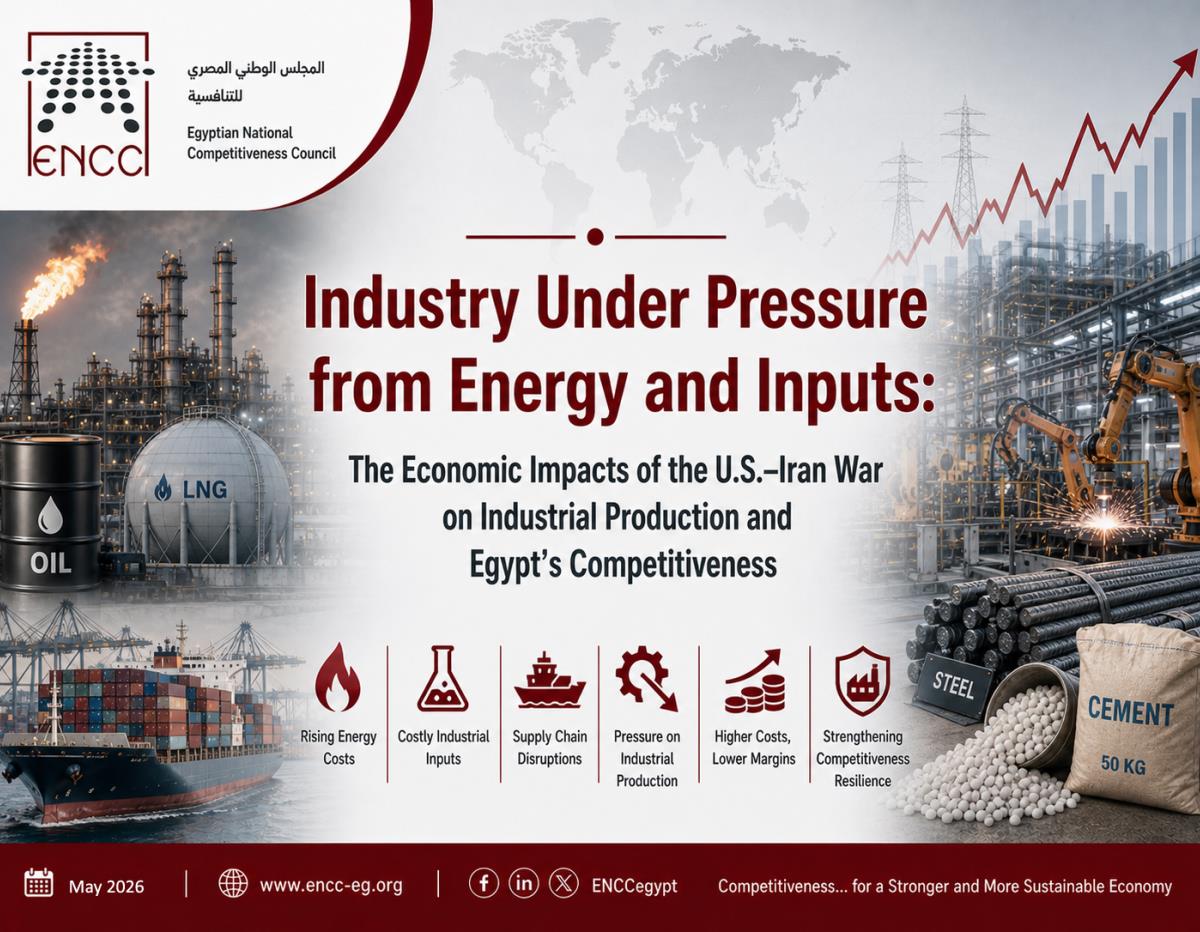
Industry Under Pressure from Energy and Inputs: The Economic Impacts of the U.S.–Iran War on Industrial Production and Egypt’s Competitiveness
A sector report from the Egyptian National Competitiveness Council on the channels through which the war transmits into industrial energy, inputs, supply chains, financing, exports, and Egypt’s industrial environment
1. ENCC institutional opening note
1.1 Short opening note
The Egyptian National Competitiveness Council (ENCC) issues this sector report as the third sectoral report within the Council’s series on the economic impacts of the ongoing war between the United States and Iran. This release focuses on the industrial sector, as a central channel through which the war’s effects transmit into production, energy costs, inputs, supply chains, financing, exports, and the competitiveness of the Egyptian economy. The report is based on a dedicated, in-depth sectoral research pack for this topic.
2. Main title
Industry under pressure from energy and inputs: the economic impacts of the U.S.–Iran war on industrial production and Egypt’s competitiveness
3. Subtitle
A sector report from the Egyptian National Competitiveness Council on the channels through which the war transmits into industrial energy, inputs, supply chains, financing, exports, and Egypt’s industrial environment
4. Executive summary
4.1 Executive summary
- The U.S.–Iran war has turned into a global industrial shock because it hits energy, gas, petrochemicals, fertilizers, metals, shipping, insurance, and financing all at once.
- The near-complete disruption in the Strait of Hormuz disturbed about 20% of globally seaborne oil and liquefied natural gas, and about one-third of global fertilizer trade, making the industrial shock broader than a simple rise in oil prices.
- Heavy industries in the Gulf came under severe pressure, especially aluminum, petrochemicals, and fertilizers, with risks of production stoppages or cuts in countries dependent on gas and exports through Hormuz.
- For Egypt, monthly energy import costs rose from about $1.2 billion in January to about $2.5 billion in March 2026, due to higher gas and petroleum prices and the stoppage of Israeli gas flows estimated at about 1.1 billion cubic feet per day.
- Industrial energy costs in Egypt rose sharply; gas prices for the fertilizer industry approached $9–10 per million thermal units, while commercial electricity tariffs rose by about 20%, and fuel prices increased by as much as 30%.
- Egypt’s non-oil private sector recorded a slight contraction, with the PMI falling to 48.0 in March 2026 from 48.9 in February, while expectations for future output moved into negative territory for the first time in the history of the index.
- Despite these pressures, the import-restriction crisis of 2022 did not recur; the Central Bank succeeded in managing foreign-currency availability for industrial inputs, allowing factories to continue operating, albeit at a higher cost.
- The crisis also reveals a competitive opportunity for Egypt to attract alternative industrial investment; the Suez Canal Economic Zone attracted major investments, including nine new projects worth $182.5 million in April 2026, in addition to Turkish and Chinese investments in textiles and aluminum.
- Local building-material prices rose under energy and input pressure; investment-grade rebar reached around EGP 35,785 per ton, while gray cement reached around EGP 3,980 per ton.
- The main conclusion is that Egypt is facing a dual industrial shock: an immediate cost pressure on factories, and a medium-term strategic opportunity for industrial repositioning if energy, financing, and logistics are managed intelligently.
5. Why the industrial sector matters in this war
5.1 Industry as a channel of production, employment, and exports
The industrial sector is one of the main channels through which external shocks move into the real economy. Industry is linked to employment, exports, intermediate inputs, supply chains, investment cost, and price competitiveness. When energy costs rise, shipments are disrupted, or financing conditions tighten, the impact quickly appears in output, factory margins, and final goods prices.
5.2 The relationship of energy and inputs to industrial competitiveness
Modern industry depends on stable energy and regular inputs. Gas, electricity, and fuel are not simply operating costs; they determine factories’ ability to plan, price, and export. Petrochemicals, fertilizers, metals, imported components, and spare parts also represent essential inputs for many production chains.
5.3 Why Egypt is a central case in this sector
Egypt is a central case because it combines exposure and opportunity. It imports energy and some industrial inputs, and is affected by the exchange rate, shipping, and financing. At the same time, it has a large market, a diversified industrial base, a geographic position close to Europe and Africa, and industrial zones such as the Suez Canal Economic Zone that can benefit from the global reconfiguration of supply chains.
6. Channels through which the impact transmits into the industrial sector
6.1 The energy channel and the cost of production
The war raises global energy costs, which places pressure on energy-intensive industries such as iron and steel, cement, ceramics, glass, fertilizers, and petrochemicals. The research indicates Brent crude moved above $120 per barrel after the disruption in Hormuz, while Asian LNG prices jumped by more than 140%.
For Egypt, the impact is not transmitted only through global prices, but through the energy import bill, industrial gas pricing, electricity tariffs, and consumption-rationing decisions.
6.2 The gas, electricity, and fuel channel
Israeli gas flows to Egypt—estimated in the research at about 1.1 billion cubic feet per day—stopped, increasing Egypt’s reliance on higher-cost LNG cargoes. At the same time, local prices for industrial gas, electricity, and fuel moved upward. This means Egyptian factories now face higher operating costs at a time when they are also under financing and logistics pressure.
6.3 The petrochemicals, fertilizers, and chemical inputs channel
The Gulf is a major node for petrochemicals, fertilizers, and chemical inputs. The research indicates that about 46% of seaborne urea trade, 33% of methanol, and a large share of sulfur trade pass through Hormuz. Any disruption in these chains raises the cost of plastics, fertilizers, chemicals, and packaging, and transmits into many industries within Egypt.
6.4 The metals and building materials channel
Metal and building-material markets were affected by rising energy, shipping, and exchange-rate costs. In Egypt, these pressures appeared in higher rebar and cement prices, which puts pressure on construction, real estate projects, and infrastructure, and also affects linked industries such as ceramics, glass, and finishing materials.
6.5 The imported inputs and intermediate components channel
Many Egyptian industries depend on imported inputs: components, machinery, spare parts, chemicals, packaging materials, and intermediate raw materials. Higher shipping, insurance, and exchange-rate costs raise expenses even when the inputs remain physically available. The research indicates that the current situation differs from the 2022 crisis because foreign-currency availability constraints have not reached the level of causing broad disruption to industrial imports.
6.6 The shipping, insurance, and supply chains channel
Transit through Hormuz fell sharply, while marine insurance premiums rose from normal levels estimated at around 0.02% to between 1% and 3%, and in extreme cases may reach 7.5%. Rerouting vessels around the Cape of Good Hope also adds 10–15 days to shipping time. This is not just a transport cost; it is also a cost of inventory, financing, production delays, and uncertainty.
6.7 The financing, exchange-rate, and working-capital channel
Higher interest rates, currency pressure, and more expensive inputs all raise working-capital needs. A factory that used to finance a normal production cycle now needs more liquidity to purchase the same inputs, finance longer shipping, and carry higher precautionary inventories. Therefore, trade-finance conditions and bank credit become decisive for continuity of production.
6.8 The demand, confidence, and industrial-investment channel
When costs rise and uncertainty widens, expansion and investment decisions weaken, and firms become more cautious in hiring, inventories, and orders. This is reflected in the Egyptian PMI falling to 48.0, and in future-output expectations moving into negative territory.
7. The global impact on industry
7.1 Energy and the cost of industrial production
Globally, energy-intensive industries are under direct pressure because of higher oil and gas prices. In Europe and Asia, this affects iron, cement, chemicals, glass, and ceramics. The longer the crisis lasts, the more higher energy costs turn from a temporary shock into a factor that redistributes competitive strength among countries.
7.2 Petrochemicals, fertilizers, and intermediate materials
Petrochemicals are among the most affected sectors because of their link to gas, oil, naphtha, and petroleum gases. The research indicates that prices of some low-density polyethylene products in Europe more than doubled relative to pre-crisis levels, reflecting the effect of Gulf disruption on intermediate industries.
7.3 Metals and building materials
The metals market reacted unevenly. Aluminum rose because Gulf smelters are exposed to gas and exports, while some other metals faced pressure from weaker global demand and a stronger dollar. This shows that the war does not lift all metal prices in the same direction; it reprices them according to their position in energy and supply chains.
7.4 Inputs, components, and supply chains
Industries that depend on “just-in-time” delivery have become more fragile, especially autos, electronics, and equipment assembly. Global firms are therefore rethinking maximum-efficiency models in favor of resilience, increasing multiple sourcing and nearshoring toward final markets.
7.5 Shipping, insurance, and logistics
The logistics shock is global, not local. Higher insurance premiums and longer shipping times raise the cost of intermediate and final goods. This may lead to larger precautionary inventories and disruption of production lines that depend on components arriving at precise times.
7.6 Financing and industrial investment
With higher inflation and reduced prospects for global rate cuts, the cost of industrial finance has become higher. This delays new expansion, especially in sectors that require large capital expenditure such as metals, petrochemicals, energy, and industrial components.
7.7 Global demand and business confidence
Weaker confidence slows industrial orders. The research points to expectations of global trade growth falling to 2.8%, and global growth standing at around 3.1% in 2026, which places pressure on industrial orders and export markets.
8. Regional and Middle Eastern impact
8.1 Industrial exposure in the Middle East and North Africa
The region now shows a clear divergence. Gulf countries possess energy, petrochemicals, and metals, but are logistically constrained behind Hormuz. North African states, including Egypt and Morocco, face higher costs but also have a relative opportunity to attract alternative industrial investment serving Europe and Africa.
8.2 The effect of the Gulf and Hormuz on energy and industrial inputs
The research indicates oil production in Kuwait, Iraq, Saudi Arabia, and the UAE fell by about 10 million barrels per day because of export difficulties through Hormuz. Regional petrochemical firms such as SABIC, Equate, and Industries Qatar also face pressure on output and supply. This affects industries dependent on polymers, fertilizers, and chemicals.
8.3 The Red Sea, Suez Canal, and industrial trade routes
Disruption in the Red Sea and the Suez Canal increases the cost of trading industrial inputs between Asia and the Mediterranean. This puts pressure on factories in North Africa and the Eastern Mediterranean that depend on raw materials and components from China, India, and East Asia, but it also raises the value of local and near-Europe manufacturing.
8.4 Relative winners and losers in the region
The biggest losers are heavy industries in Qatar, Bahrain, and the UAE when they are effectively boxed behind Hormuz and lose normal export capacity. Relative winners are countries with safer logistical positions and alternative locations—especially Egypt and Morocco—if they can provide appropriate energy, financing, and industrial procedures.
8.5 What this means for industrial competitiveness in the Middle East and North Africa
The war has shown that industrial competitiveness is no longer linked only to low energy costs, but also to reliable shipping, policy stability, financing ease, and proximity to markets. This gives Egypt an opportunity to redefine its industrial advantage beyond “cheap energy” alone, toward “location, resilience, and delivery capability.”
9. Egypt: detailed sector assessment of industry
9.1 Manufacturing performance and the non-oil private sector
Indicators for Egypt’s non-oil private sector show clear pressure. The PMI fell to 48.0 in March 2026, down from 48.9 in February. This indicates continued contraction in private activity, with deterioration in future-output expectations because of regional uncertainty. At the same time, CAPMAS data showed a temporary 1.5% increase in the manufacturing and extractive industries index in February before the full impact of the crisis appeared in March.
9.2 Energy-intensive industries
Energy-intensive industries face the greatest pressure, especially iron and steel, cement, ceramics, glass, and fertilizers. These sectors depend on gas, electricity, and fuel, and are directly exposed to price changes. Higher energy costs do not only cut margins; they can also change production, pricing, and export decisions.
9.3 Gas, electricity, fuel, and the cost of production
Egypt’s monthly energy import bill rose to $2.5 billion in March, versus $1.2 billion in January. In response, the government moved toward more market-linked pricing for industrial gas, removed subsidies on gas for new factories, and partially linked gas prices for fertilizer plants to global urea prices, pushing costs to $9–10 per million thermal units. Commercial electricity tariffs also rose by about 20%, while fuel prices increased by as much as 30%.
9.4 Petrochemicals, fertilizers, and chemical industries
Despite higher costs, chemicals and fertilizers remain central to exports. The research indicates chemical-sector investments of about $1.8 billion are expected in 2026/2027. Local urea prices also reached around EGP 23,479 per ton, while ammonium nitrate reached around EGP 22,368 per ton in early February. The paradox here is that high global prices may support exports, while at the same time raising local gas and production-input costs.
9.5 Iron, steel, cement, ceramics, glass, and building materials
The building-materials sector was directly affected. Investment-grade rebar rose by about EGP 1,000 to EGP 35,785 per ton, while Ezz Steel reached about EGP 37,600 per ton, and gray cement climbed to around EGP 3,980 per ton. These increases put pressure on construction, real-estate development, and infrastructure projects, and can transmit into higher unit prices and capital costs.
9.6 Imported inputs, machinery, components, and spare parts
Despite higher imported-input costs, the research confirms that factories did not face the wide import constraints seen in the 2022 crisis. The Central Bank maintained sufficient FX liquidity to prevent a broad stoppage in imports of intermediate materials and spare parts. This is an important absorber, though it does not remove the higher costs caused by the pound, shipping, and insurance.
9.7 Exchange rate, working capital, and trade finance
Factories face greater working-capital pressure. Higher input prices, interest rates, shipping costs, and exchange-rate moves increase the financing required for each production cycle. Therefore, accessible and disciplined finance becomes critical for continuity, especially for SMEs that do not have large liquidity buffers.
9.8 The Suez Canal, the Red Sea, ports, and industrial logistics
Even with weaker Suez Canal revenues, the Suez Canal Economic Zone benefits from industrial repositioning. The research indicates that the zone attracted $15 billion in investments, including 70% foreign, and in April 2026 launched nine industrial projects worth $182.5 million in the Sokhna integrated area. This shows that maritime disruption can be turned into an opportunity if linked to local export-oriented production.
9.9 SMEs, labor, and industrial clusters
Small and medium-sized industrial projects need special support because they are more sensitive to interest rates, energy, and inputs. The research notes that the preferential-finance initiative for priority industrial sectors expanded, with the financing ceiling raised to EGP 100 million per client at a subsidized rate below 15%. The Industrial Development Authority also offered grace periods and penalty exemptions for distressed projects through April 2026.
9.10 Industrial exports and competitiveness implications
The crisis creates an opportunity for Egyptian industrial exports if Egypt can secure energy and inputs. Turkish investments of about $500 million in textiles, and a Chinese $2 billion aluminum project in the Economic Zone, indicate that Egypt may become a destination for manufacturing located close to Europe and Africa. But this depends on stable energy, financing, and logistics.
10. Assessment by time horizon
10.1 Current / immediate impact
Immediately, the pressure appears in higher gas, electricity, and fuel prices, the PMI falling below 50, higher building-material prices, and increased working-capital needs.
10.2 Short term: 0–3 months
In the short term, the resumption of some regional gas flows may help reduce LNG pressure, but building-material and input prices are likely to remain elevated. The subsidized industrial-finance program may provide an important liquidity cushion.
10.3 Medium term: 3–18 months
In the medium term, chemicals, fertilizers, and industrial-material sectors may benefit from higher global prices and disrupted Gulf capacity if Egypt can secure energy. Some projects in the Suez Canal Economic Zone may also begin adding export capacity.
10.4 Long term: more than 18 months
Over the longer term, the crisis may deepen local manufacturing and the relocation of supply chains into Egypt, especially in aluminum, textiles, components, and chemicals. This requires turning the geopolitical opportunity into a clear and sustained industrial policy.
11. Sector scenario matrix
11.1 Scenario A — limited and short conflict
If the war ends quickly and energy prices retreat, gas, shipping, and insurance costs fall, the Suez and Red Sea recover, and Egyptian industry regains part of its margins. In this scenario, faster industrial rate relief and accelerated investment expansion become possible.
11.2 Scenario B — prolonged but regionally contained conflict
This is the scenario most consistent with the current reading. Energy remains expensive and shipping remains costly, but there is no full collapse. For Egypt, this means continued cost pressure together with an opportunity to attract alternative industrial investment. That requires affordable finance, longer-term energy contracts, and logistics support for exporters.
11.3 Scenario C — major regional escalation
If escalation widens and Gulf energy infrastructure is damaged, oil and gas prices rise further, and actual shortages emerge in chemicals, metals, and some inputs. For Egypt, this would create severe pressure on factories and could even force gas rationing for some heavy industries, increasing the importance of prioritizing export- and job-generating sectors.
11.4 Scenario D — maximal regional war
In this scenario, major routes are disrupted and broad supply chains stop functioning. Many factories globally face stoppages, and Egypt would face severe pressure on foreign currency, energy, and inputs. The priority then becomes maintaining strategic industries, rationing energy, and securing essential materials.
12. What does this mean for Egypt?
12.1 Strategic interpretation
The deeper economic meaning of the industrial shock is that the war does not only raise energy costs—it reshapes the industrial competitiveness equation itself. Industry that relied on cheap energy, imported inputs, and regular shipping now faces a world of higher cost and lower certainty.
For Egypt, the challenge is to prevent higher energy and input costs from turning into a lasting weakening of competitiveness. Gas, electricity, and fuel inflation can pressure factories, but Egypt’s large market, proximity to Europe and Africa, and active industrial zones create an offsetting opportunity.
The crisis also shows that Egypt’s future industrial advantage should not be built only on low energy costs, because that advantage has become less stable. A stronger basis is location, diversified industry, faster release of inputs, industrial finance, and investment in efficiency and alternative energy.
The biggest opportunity is that disruptions in the Gulf and Asia are pushing global firms to look for alternative manufacturing locations. If Egypt can protect production stability, provide energy, and facilitate financing, the crisis may become a launch point for deeper import substitution and stronger industrial exports.
13. Council considerations and recommendations to government
13.1 Priorities for industrial energy stability
Priority should be given to stable energy supply for export- and employment-generating industries, together with a transparent mechanism to identify sectors of priority if gas or electricity pressures intensify.
13.2 Priorities for gas, electricity, and fuel
Industrial policy needs predictable energy pricing, even if it is not low. What matters most for factories is clarity on pricing rules and the limits of change, allowing for planning, contracting, and exporting.
13.3 Priorities for critical industrial inputs
A list of critical industrial inputs should be identified and protected from disruption due to FX or shipping pressures, especially chemicals, spare parts, intermediate raw materials, and inputs for exporting industries.
13.4 Priorities for shipping, ports, and logistics
The role of ports and integrated industrial zones—especially in the Suez Canal Economic Zone—should be strengthened to reduce release time, storage cost, and transport burdens.
13.5 Priorities for trade finance and working capital
Concessional finance should continue for priority industrial sectors, with focus on working capital, not only machinery and equipment financing, because the current problem is the cost of the operating cycle itself.
13.6 Priorities for supporting energy-intensive industries
Instead of broad energy support, conditional tools can be used, tied to energy efficiency, exporting, preserving jobs, or investment in solar energy and lower-consumption technologies.
13.7 Priorities for SMEs and industrial clusters
Industrial SMEs need anti-distress tools, grace periods, easier credit, and access to inputs, because they are the least able to absorb the shock.
13.8 Priorities for exports and industrial competitiveness
Industrial policy should be linked to the global repositioning opportunity through targeted incentives for export-oriented manufacturing investment, and easier market entry for Turkish, Chinese, and European firms seeking near-market alternatives.
14. Council considerations and recommendations to business and private investors
14.1 Energy-intensive factories
These factories should re-evaluate energy costs in their financial models, invest in efficiency, and diversify sources wherever possible.
14.2 Chemicals, petrochemicals, and fertilizer industries
Firms need to balance export opportunities at high global prices with the need to preserve domestic market stability, especially if gas costs rise or input constraints intensify.
14.3 Iron, steel, and building materials
Companies need tight inventory and pricing management, because higher raw-material and energy costs can affect construction and real-estate demand if full increases are passed through.
14.4 Industries dependent on imported inputs
Suppliers should be diversified, supply-chain visibility improved, and local or regional substitutes explored for sensitive components.
14.5 Industrial exporters
Exporters have an opportunity to benefit from disruption among suppliers in the Gulf and Asia, but this requires securing energy, shipping, and finance contracts while maintaining delivery quality and timing.
14.6 Industrial SMEs
These firms should make use of the available concessional-finance tools, review cash and inventory cycles, and avoid uncalculated expansion in a high-interest, high-input-cost environment.
14.7 Inventory, procurement, and logistics management
It is important to move from an ultra-low-inventory model to a more balanced one, especially for spare parts and critical raw materials whose absence may stop an entire production line.
14.8 Financing, hedging, and exchange-rate management
Companies need to stress-test their exposure to exchange rate, interest rates, and energy, and use longer contracts or commercial hedging where possible to reduce surprises.
15. What should be monitored next?
15.1 Global indicators
- Oil and LNG prices
- Petrochemical, urea, and methanol prices
- Aluminum, steel, and copper prices
- Shipping and marine insurance indicators
- Global industrial-demand and trade indicators
15.2 Regional indicators
- Gas supply in the Gulf and Eastern Mediterranean
- Decisions by Gulf petrochemical companies on output or force majeure
- Movement through Hormuz, the Red Sea, and the Suez Canal
- Trends in industrial relocation toward North Africa
- Gulf exports of metals and petrochemicals
15.3 Egypt indicators
- Egypt PMI
- Monthly energy import bill
- Industrial gas, electricity, and fuel prices
- Local prices of steel, cement, and fertilizers
- FX availability for industrial inputs
- Customs release rates for raw materials and spare parts
- Developments in Suez Canal Economic Zone investments
- Use of the concessional industrial-finance initiative
- Industrial export orders
- Announcements of production cuts or expansions
16. Institutional closing note
16.1 Closing note
This sector report shows that Egyptian industry stands at a precise moment: immediate pressure on energy, inputs, and finance, together with a medium-term opportunity for industrial repositioning and attraction of new supply chains. The real test is not only absorbing higher costs, but turning regional disruption into a broader path for deeper industrialization, larger exports, and stronger industrial competitiveness in Egypt.
17. Sources and evidence note
17.1 Sources and evidence note
This report draws on deep research dedicated to the industrial sector, based on high-trust official, institutional, market, and analytical sources, with a special focus on linking energy, inputs, supply chains, financing, and logistics channels to industrial competitiveness in Egypt and the region.
Official and institutional sources: data and indicators from Egyptian and international bodies related to industry, energy, finance, trade, and the Suez Canal Economic Zone.
Market and sector sources: PMI indicators, industrial commodities, petrochemicals, metals, shipping, insurance, and industrial investment data.
High-trust analytical and media sources: economic and sectoral analytical institutions, and international and regional economic media sources used in the base research material.