

The U.S.–Iran war: renewed escalation puts energy routes under pressure and tests Egypt’s capacity
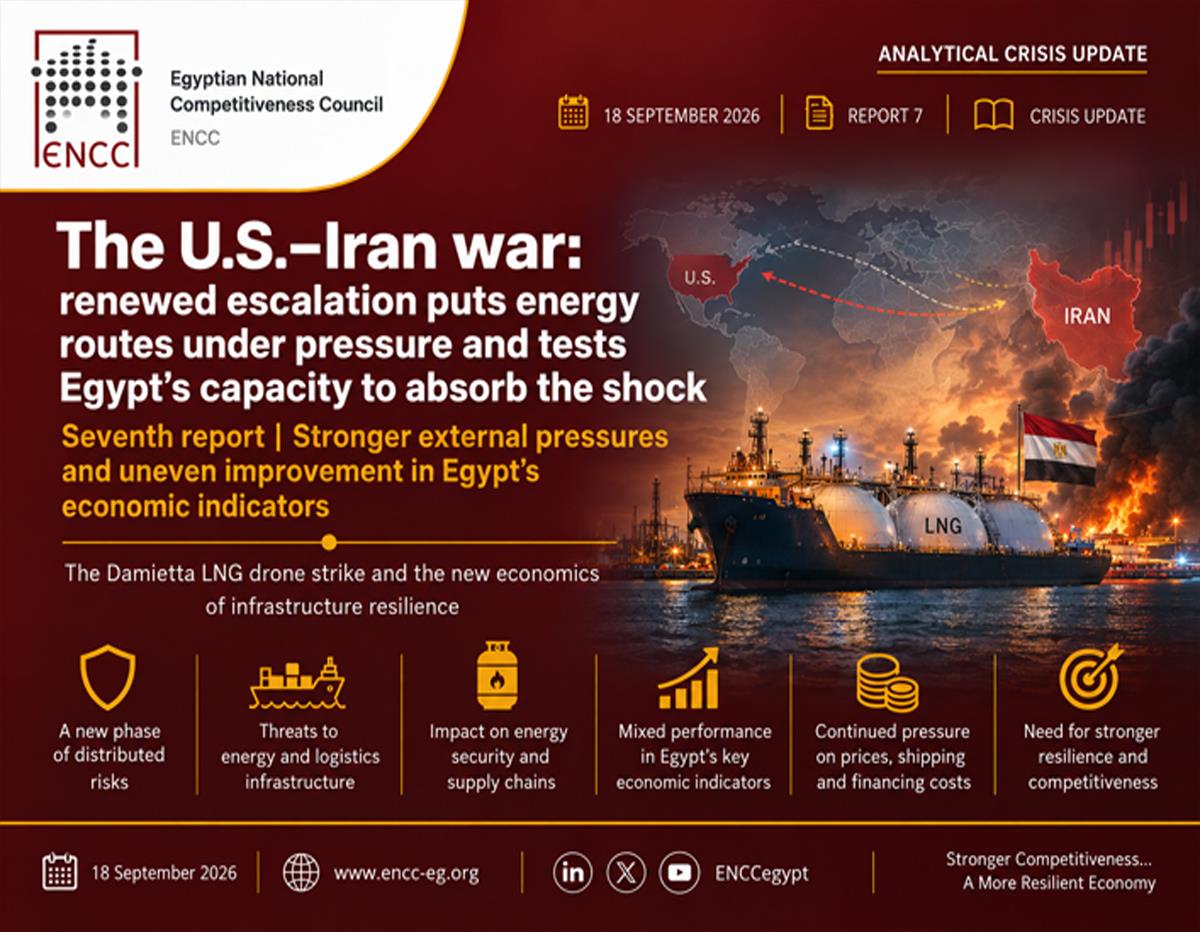
The Egyptian National Competitiveness Council continues to monitor the economic implications of the ongoing war between the United States and Iran, as part of its work assessing developments that affect Egypt’s competitiveness and business environment. This seventh report extends the monitoring published through 1 August 2026, distinguishing verified facts from forward-looking assessments and matters that remain unconfirmed.
The U.S.–Iran war: renewed escalation puts energy routes under pressure and tests Egypt’s capacity to absorb the shock
Seventh report | Stronger external pressures and uneven improvement in Egypt’s economic indicators
18 September 2026 — Monitoring period: 2 August to 18 September 2026, through 00:36 Cairo time. This assessment does not cover the remainder of 18 September after that cutoff.
Executive summary
- The economic assessment has shifted to renewed military and economic escalation. Renewed hostilities and expanding sanctions weaken the description of the phase as merely indirect escalation under a ceasefire. The precise legal status of de-escalation arrangements still requires independent verification.
- The security of alternative energy routes has become more important. The incident affecting Saudi Arabia’s East–West pipeline showed that bypassing one maritime passage does not eliminate supply risk if the alternative route is itself disrupted.
- The energy shock cannot be reduced to the price of crude oil. Pressures on refined products and liquefied natural gas, together with shipping and financing costs, jointly affect the cost of the supplies Egypt needs.
- Salvage of the damaged gas unit at Damietta has progressed, without verified restoration of service. It was refloated in August, and an expected return during the fourth quarter was announced. Actual commercial operation remains the measure of recovery.
- The sanctions assessment requires a baseline correction. U.S. General License X was revoked in July. It is therefore incorrect to present 21 August as a new expiry date for an authorization that remained in force until then.
- International reserves rose to approximately USD 57.21 billion at the end of August. Changes in their composition, with a higher gold valuation and a lower foreign-currency component, prevent the entire increase from being interpreted as a new inflow of dollar cash.
- Urban headline inflation declined to 14.5% in August, while core inflation reached 14.9%. This movement reflects diverging price pressures rather than a comprehensive easing.
- The non-oil private-sector activity reading improved without reaching expansion. The Purchasing Managers’ Index stood at 49.6, compared with 46.8 in July, while differences persisted across sectors and firms.
- Financing conditions remain restrictive. Egyptian interest rates were held in the latest verified decision, while U.S. rates increased. Working-capital management and refinancing risk therefore warrant greater attention.
- Egypt’s priority is to secure continuity and preserve its capacity to absorb the shock. The assessment combines critical external risks with elevated Egyptian exposure, without extrapolating disruption at one facility to the whole economy or assuming a recovery that the data have not established.
Introduction to the update
This report builds on the sixth report and covers developments after the end of its monitoring period. The central change is the widening range of risks to energy flows: from the security of traditional passages to the reliability of alternative land and sea routes, and from the purchase price of a commodity to the ability to ship, insure, pay for and receive it when required.
For Egypt, the indicators are not moving in a single direction. Some buffers and activity readings have improved as the external environment has become more difficult. Economic decisions therefore need to distinguish the reliability of the domestic supply system from the cost of maintaining that reliability and the sustainability of financing it if disruption persists.
What has materially changed?
Broader military and economic pressure
Converging reports of renewed hostilities, alongside announced U.S. measures, support the description “renewed military and economic escalation; disrupted energy routes.” This does not establish that every negotiating arrangement has ended or that a comprehensive ceasefire is in force. The economic impact also depends on the implementation of understandings and the stability of flows. Reporting on renewed hostilities.
Developments included a U.S. sanctions campaign announced on 24 August, a tightening of licensing policy on 10 September, and a new designation on 17 September. These measures call for scrutiny of counterparties, payment routes and transaction-related services. The licensing policy should not be understood as an absolute prohibition without exceptions; its provisions and limits must be consulted. Confirmation of a designation also does not amount to independent verification of every allegation in the issuing authority’s statement. U.S. Treasury announcement, licensing policy, 17 September action.
Baseline correction: General License X was revoked on 7 July and replaced by X1, with limited wind-down arrangements that ended on 17 July. The alert concerning a 21 August expiry is therefore excluded from the assessment of new developments. Revocation announcement, replacement license text.
New tests for alternative routes
An attack on Saudi Arabia’s East–West pipeline was reported on 10 September, followed by official confirmation relayed in the sources and a precautionary shutdown. The specialist review of satellite imagery explains that thermal detections do not automatically equal the number of direct impacts or pipeline ruptures. This monitoring exercise did not establish an independent finding on the perpetrator or a verified figure for continuing realized export losses. Revised Payne Institute assessment.
For Egypt, the economic implication is the need to test supply alternatives against the simultaneous disruption of more than one route. Diversifying suppliers is insufficient if their cargoes rely on the same chokepoints. Equally, the greater strategic importance of an Egyptian route does not automatically guarantee higher transit volumes or revenue.
Partial progress toward restoring the Damietta unit
Energos Winter was refloated on 6 August, while a ministerial statement on 1 September envisaged its return during the fourth quarter of 2026. These are distinct milestones: refloating is a salvage step, and the expectation is a target. Actual restoration requires repair, technical certification, commissioning tests and evidence of gas send-out. Refloating report, ministerial statement.
Attribution of the incident to a particular party remains plausible but unconfirmed; a hypothesis is not treated as an investigation finding. The unit’s design capacity is also not used as a verified measure of Egypt’s net daily supply shortfall.
What has not changed?
The main transmission channels persist through energy and food imports, shipping reliability, financing costs and the sensitivity of some foreign-currency revenue sources to regional disruption. The available evidence is insufficient to declare a broad and sustained return to normal shipping, restored commercial operation of the Damietta unit, or a conclusive attribution of the incident.
Nor is there a consolidated, verified estimate of the war’s total cost to Egypt or of tourism, production and employment losses during the update period. These are measurement gaps: they neither imply an absence of impact nor justify assuming a particular loss.
Updated impact assessment by level
| Level | Updated assessment | Economic implication |
|---|---|---|
| Global | Critical energy and logistics risks | Delivered supply cost, product availability and financing matter more than tracking crude prices alone |
| Regional | Wider exposure of infrastructure and alternative routes | Test interdependencies among ports, pipelines, passages and insurance |
| Egypt | Elevated exposure with improvement in some buffers | Prioritize service and production continuity, replacement costs and liquidity management |
The International Energy Agency recorded intensifying pressure on refined products and a draw of 95 million barrels from observed global oil inventories in August. The agency’s September assessment. An intraday reading put Brent at USD 102.72 per barrel and West Texas Intermediate at USD 100.47 at 13:24 UTC on 17 September; this was a trading-session observation, not a closing price. Price observation.
In gas markets, the European benchmark reached USD 27.0 per million British thermal units on 11 September for October delivery, while the Asian benchmark traded in the mid-USD 28s. These are market references, not Egypt’s contract prices or landed costs. Other factors, including the Russia–Ukraine war, maintenance, weather and demand, also influence prices. Japanese weekly gas report.
Egypt: detailed updated assessment
Energy and LNG: continuity and its cost
An energy-security assessment must distinguish the theoretical capacity of facilities, capacity actually available, gas reaching the grid, and the net shortfall after alternatives are deployed. Progress in salvaging a damaged unit is insufficient to establish that replacement arrangements are no longer needed.
The practical question is the cost of securing an additional unit of energy and the reliability of its delivery. The answer includes the cargo price, freight, insurance, regasification and credit, as well as payment timing. Data on pipeline gas receipts and utilization of the Ain Sokhna, Damietta and Idku facilities also need updating before an aggregate assessment of the ability to meet demand can be made. The available sources do not provide sufficient measurement to fill these gaps with verified current figures.
Electricity: protecting service and monitoring early signs of pressure
This update did not establish the introduction of a new nationwide power-outage regime. Risks are therefore framed as contingencies linked to fuel availability, arrival timing and the cost of operating alternatives.
Regular monitoring of usable fuel stocks, expected loads, outages and plants’ flexibility to use alternative fuels can identify pressure early. Where exceptional measures become necessary, clear rules protecting essential services and critical productive activities can reduce disruption and uncertainty.
Food and inflation: diverging indicators
The global Food Price Index reached 133.3 in August, up 1.9% month on month, on a basis where the 2014–2016 average equals 100. Food and Agriculture Organization. This movement does not pass through mechanically to Egyptian consumers: purchasing terms, exchange rates, stocks, distribution and the timing of pricing decisions all intervene.
Domestically, urban headline inflation was 14.5% year on year in August, compared with 14.9% in July, while core inflation rose from 14.7% to 14.9%. These movements underline the need to read both measures together and monitor essential goods and households’ real incomes. A separate numerical contribution from the war should not be calculated without a credible causal estimate that distinguishes it from other factors. Central Bank of Egypt release, corroborating coverage.
Reserves, foreign exchange and financing
International reserves of approximately USD 57.21 billion at the end of August represent an important buffer. Yet the simultaneous increase in gold valuation and decline in the foreign-currency component require an assessment of reserve composition, not just the total. Adequacy also depends on commitments, payment schedules, essential imports and available liquidity. Reserve and composition data attributed to the Central Bank of Egypt.
The latest verified Egyptian decision, on 20 August, retained the deposit rate at 19% and the lending rate at 20%. On 16 September, the U.S. Federal Reserve raised its range by 25 basis points to 3.75–4.00%. Egyptian interest-rate decision, U.S. decision.
This environment reinforces the importance of managing liquidity, debt maturities and trade finance. It does not, however, establish a particular change in Egypt’s sovereign yield spread, credit-default insurance cost or exchange rate: verification of a consistent current series for these indicators was not completed.
Suez Canal, SUMED and shipping
An alternative route can benefit only if actual cargoes are available to use it, both legs of the journey are secure, and insurance and financing are available. Crude, product and LNG tankers must therefore be distinguished from container ships, and individual transits from the return of a regular service.
No recent, comparable official series was available to establish a broad return to normal traffic or of the largest container vessels. For SUMED, actual cargo nominations, operating capacity and activity at its associated ports remain decisive. Higher revenue cannot be inferred automatically from greater geographic importance.
Ports, insurance and infrastructure security
The Damietta experience supports reviewing physical separation between sensitive assets, isolation and emergency procedures, access to salvage equipment, and coordination among facility operators, the port and the relevant authorities. Exposure mapping should reflect the position of each facility, without generalizing from one incident to all Egyptian ports.
Insurance costs depend on the voyage, asset, coverage, exclusions and deductibles. This monitoring exercise did not verify a new blanket Joint War Committee classification covering all Egyptian ports. The relevant evidence is therefore the actual terms offered to operators, rather than broad regional generalizations.
Tourism and aviation
The verified data available do not support a new consolidated loss estimate or establish stable demand across all markets. Bookings, cancellations, airline seat capacity, occupancy and destination- and route-specific advisories require continued monitoring.
Separating the effect of regional perceptions from actual flight restrictions helps guide marketing, communication and capacity management. Forward bookings should also be distinguished from realized arrivals and receipts, to avoid premature conclusions from a partial indicator.
Industry, competitiveness and the business environment
The non-oil private-sector Purchasing Managers’ Index improved to 49.6 in August but remained below the 50 threshold separating improvement from deterioration in business conditions. It is not a measure of industrial output growth or evidence that all factories have recovered. AmCham reporting based on the index issuer.
Conditions in fertilizers, petrochemicals, steel and cement differ according to energy intensity, fuel type, raw materials and export commitments. Current production and operating disclosures are therefore needed, and old shutdown reports should be excluded from assessments of the present situation. Global selling prices for some products may improve while margins narrow because input costs rise or production is disrupted.
Competitiveness in this phase depends on reliable energy, customs clearance, payments and information, alongside prices. Reducing uncertainty in these areas can protect supplier networks and jobs without assuming that every sector needs the same intervention.
Public finances and employment
Fiscal pressures arise through fuel-purchase timing, subsidies, public entities’ liquidity needs and social-protection measures. No verified estimate is available to support a new aggregate statement of the war’s cost to the budget.
Assessment requires separating the import bill from the amount actually borne by the budget and avoiding double-counting. Labor-market monitoring needs indicators of operating hours, hiring and delayed supplier payments, alongside employment: operational pressure may appear before it is reflected in job-loss data.
Sectoral signals
| Sector | Current signal | Monitoring priority |
|---|---|---|
| Energy security | Elevated exposure and pressure from replacement costs | Cargo arrivals, flows and actually available capacity |
| Electricity | Risks requiring preparedness, without a verified new nationwide disruption | Fuel availability, outages and peak loads |
| Food | Import pressure with uneven domestic pass-through | Delivered cost, stocks and essential prices |
| Tourism and aviation | Heightened monitoring without a verified loss estimate | Bookings, cancellations and air capacity |
| Industry, fertilizers and petrochemicals | Sector variation and slower overall contraction | Current disclosures on production, gas and exports |
| Steel, cement and construction materials | Potential input and liquidity pressure | Energy, orders, costs and margins |
| Consumer finance | Sensitivity to real income and funding costs | Delinquencies, repayment capacity and credit terms |
| Marine insurance and ports | Exposure specific to each voyage and facility | Coverage, exclusions and operating certification |
Update by time horizon
Over the following days and two weeks: priorities center on contracted cargoes, the ability to execute payments, fuel and essential-service continuity, and any verified development affecting infrastructure or de-escalation.
Over one to three months: documented restoration of operating capacity, the cost of replacement contracts, and developments in inflation, activity and tourism demand become key measures of absorption capacity. The fourth-quarter target for the Damietta unit remains an expectation to be monitored.
Over three to twelve months: the deeper impact depends on the duration of disruption, contract repricing, the cost of capital, energy efficiency, public spending and investment decisions.
Scenario update
| Scenario | Direction relative to the previous update | Current assessment |
|---|---|---|
| A — Limited and short conflict | Decreased | Continuing disruption and renewed hostilities weaken the prospect of a rapid settlement with limited effects |
| B — Prolonged but regionally bounded conflict | Decreased | Prolongation persists, but wider exposure of routes and infrastructure puts the containment assumption under pressure |
| C — Major regional escalation | Increased | Supported by military and economic escalation channels and infrastructure risks |
| D — Extreme regional war | Increased | Exposure to the most severe outcomes associated with additional system failures has increased; this does not mean the scenario has materialized |
The directions express qualitative analytical judgments. They are not numerical probabilities or shares that must add up to a percentage. The operating-phase description remains separate from the scenarios: renewed military and economic escalation; disrupted energy routes.
What does this mean for Egypt?
The main challenge is to keep the economy operating reliably at a sustainable cost. Reserves and alternative capacity provide room to absorb the shock, but they do not eliminate the cost of using those alternatives or its impact on the budget, liquidity and prices.
Egyptian exposure in this update is classified as elevated, with a mixed direction. This assessment reflects corrected assumptions about realized supply losses, improvement in some indicators, and the absence of a verified nationwide breakdown. It is not a calculated reduction in risk probability or a declaration that the crisis has ended. Overall risk in the external environment remains critical and deteriorating.
The Council’s considerations and recommendations for government
- Link supply security to operational information. Develop a consolidated view of confirmed cargoes, usable stocks, actual facility capacity and payment dates, identifying gaps before they become disruptions.
- Publish recovery milestones using clear definitions. Distinguish refloating, repair, certification, commissioning and commercial send-out in public disclosures, supporting confidence without raising expectations before delivery.
- Test alternatives against simultaneous route disruptions. Include ports, pipelines, insurance and payments in continuity plans, rather than relying solely on a larger number of suppliers.
- Direct protection toward the greatest needs. Prioritize essential goods and services and the most affected households, while assessing the effect of any price intervention on availability and public cost.
- Separate fiscal transmission channels. Estimate the energy bill, subsidies, public-sector liquidity needs and support measures separately, avoiding double-counting of losses.
- Improve regular sector data. Provide comparable indicators for transit, operations, tourism and energy, with clear reference periods, definitions and methodology.
The Council’s considerations and recommendations for business and private investment
- Stress-test liquidity and working capital against higher inventory costs and delays in supply and collections, linking decisions to the firm’s financing capacity.
- Review contracts and compliance across counterparties, payments, guarantees and services, seeking the appropriate expertise when applying provisions to a specific transaction.
- Diversify operating routes as well as suppliers, and review concentration in transport, storage and energy at any single point.
- Examine actual insurance coverage, including exclusions, deductibles and business-interruption limits, without assuming that the existence of a policy covers every form of disruption.
- Use documented operating capacity when planning production and delivery, without equating an expected asset-recovery date with a confirmed return to service.
- Protect relationships with suppliers, employees and customers through clear communication and flexible planning, using current disclosures to assess demand and production rather than generalizing from sector headlines.
What should be monitored next?
- The texts of understandings and de-escalation arrangements, their implementation, and any verified new escalation.
- Saudi pipeline operation and actual flows following repairs.
- Technical certification, commissioning and commercial gas send-out at the Damietta unit.
- Gas and fuel arrivals in Egypt and utilization of each facility individually.
- Sanctions and licensing updates, payment terms and insurance conditions.
- Central Bank of Egypt decisions, inflation, reserve composition and financing conditions.
- Suez Canal traffic by vessel type, SUMED nominations and regular services.
- Industrial disclosures, electricity continuity, bookings and airline seat capacity.
- Any independent findings establishing responsibility for infrastructure incidents.
Institutional closing note
The Egyptian National Competitiveness Council considers that managing this phase requires protecting economic continuity, preserving the resources available to absorb the shock, and improving the information on which decisions are based. A disciplined assessment of developments allows interventions to be targeted more precisely and helps avoid overstating losses or prematurely declaring recovery. The Council will continue to update its assessment as new operational and statistical evidence becomes available.
Note on sources and evidence
The report draws on official sources for sanctions, monetary policy and international commodities, alongside specialist reports and reliable coverage of events and Egyptian data, with links provided near the relevant claims. Dates identify the observation or decision period: the latest monthly or intraday reading is not treated as a direct measurement of every day in the monitoring window.
The identities and indexed data of some Central Bank of Egypt releases were verified, with corroborating coverage used where the original pages could not be opened in full. Part of the news verification also relied on dated indexed text. The available evidence does not support certainty about the perpetrators of incidents, current flows at some facilities, sector losses or the aggregate fiscal cost. Missing data are not treated as proof that damage is absent or that it has occurred at a particular scale.