

The Economic Impact of the U.S.-Iran War - Damietta LNG Drone Strike and Infrastructure Resilience
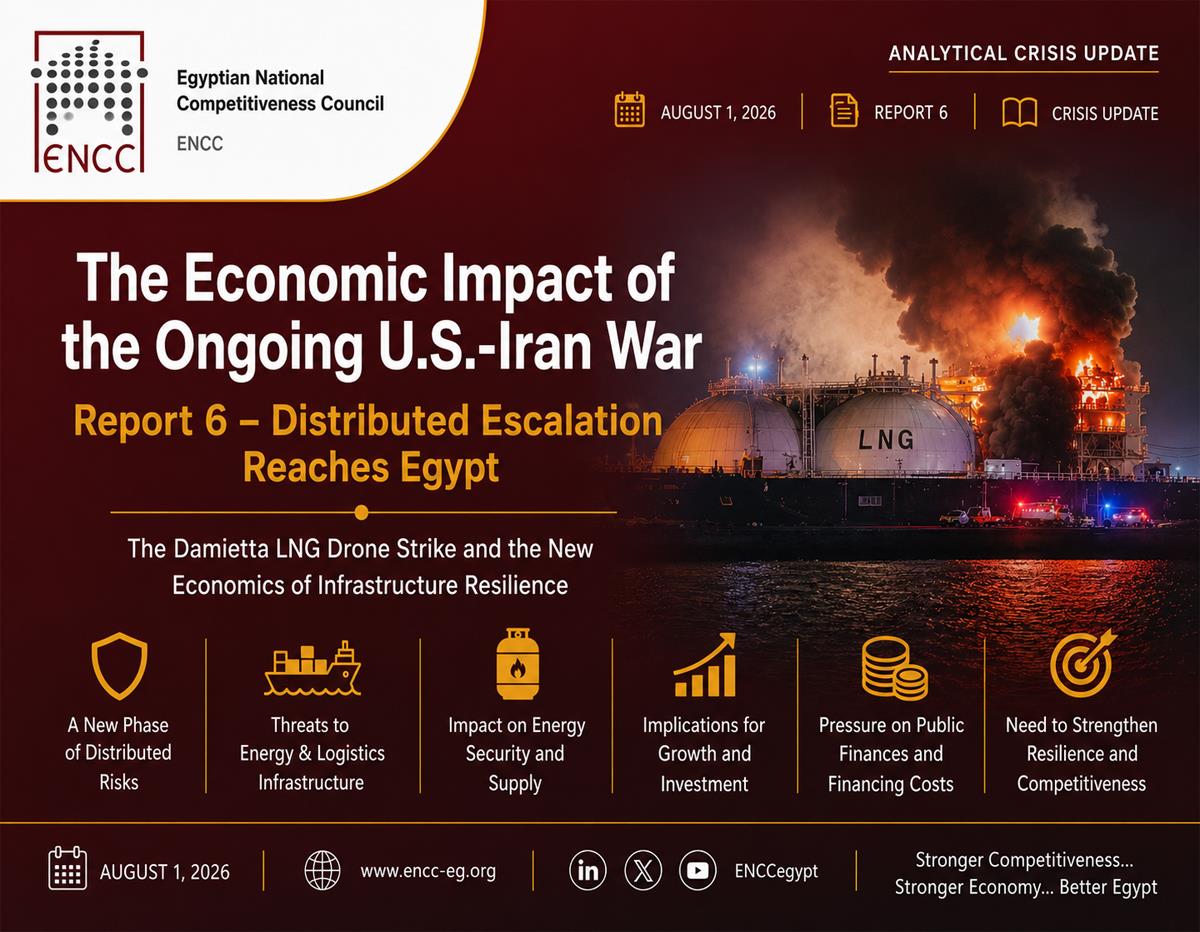
The Economic Impact of the U.S.-Iran War - Damietta LNG Drone Strike and Infrastructure Resilience
Egyptian National Competitiveness Council (ENCC) | Crisis Update
The Economic Impact of the Ongoing U.S.-Iran War
Report 6 - Distributed Escalation Reaches Egypt
The Damietta LNG Drone Strike and the New Economics of Infrastructure Resilience
| Publication date | August 1, 2026 |
| Covered period | June 24-August 1, 2026 |
| Issued by | Egyptian National Competitiveness Council (ENCC) |
| Document type | Analytical crisis update |
Executive Judgment
The July 29 drone strike at Damietta Port marks a material change in Egypt’s exposure to the ongoing U.S.-Iran conflict. Until this point, the principal transmission channels had been external: higher energy costs, disrupted shipping, weaker Suez Canal traffic, imported inflation, tourism uncertainty, and tighter financing conditions. The Damietta incident added a direct infrastructure channel by interrupting operations at a key liquefied natural gas (LNG) import and regasification node on Egyptian territory.
The immediate lesson is not that Egypt has lost control of its energy system. Emergency teams contained the fire, no casualties were reported, and alternative import and fuel options remain available. The more consequential lesson is that macroeconomic buffers cannot substitute for physical redundancy. A country may hold stronger foreign reserves and lower inflation while remaining vulnerable to the temporary loss of a strategically important terminal, vessel, pipeline, or industrial feedstock.
ENCC therefore assesses that Egypt has entered a phase of distributed escalation: economic and security risk is no longer concentrated in the Strait of Hormuz, Bab el-Mandeb, or the main conflict theatres. It can reach commercial vessels, ports, energy terminals, pipelines, and industrial supply chains across a wider geography. For Egypt, competitiveness policy must now treat energy continuity and critical-infrastructure resilience as core conditions for productivity, investment, exports, and food security.
1. Executive Summary
-
On July 29, 2026, a drone struck the Energos Winter floating storage and regasification unit at Damietta Port. The resulting fire spread to the adjacent GasLog Salem LNG vessel. Egyptian authorities confirmed drone causation; no deaths or injuries were reported.
-
The incident appears to be the first publicly confirmed attack on Egyptian territory directly associated with the current regional conflict. It changes Egypt’s risk profile from indirect economic exposure to a combination of external shocks and direct infrastructure vulnerability.
-
Responsibility for the attack had not been established by the August 1 cut-off. No actor had claimed responsibility, the Egyptian investigation remained open, and Iran denied involvement. ENCC therefore treats the attack as confirmed but its attribution as unresolved.
-
Available technical and market sources describe the Energos Winter as having a regasification or send-out capacity in the range of roughly 650-750 million cubic feet per day. The actual volume being delivered immediately before the incident, the extent of damage, and the repair timetable were not officially disclosed by the cut-off date. Percentage estimates of the unit’s contribution to national gas supply should consequently be treated as indicative rather than definitive.
-
Egypt’s gas balance was already tight before the strike. Several fertilizer and petrochemical companies announced temporary shutdowns or reductions on July 28 because of gas-supply pressures. The Damietta incident did not create that structural imbalance, but it removed flexibility from an already stressed system and increased the risk that industrial users would bear a larger share of the adjustment.
-
The main economic transmission channels are higher emergency fuel and LNG costs, industrial production losses, pressure on fertilizer availability and exports, increased maritime insurance and security costs, and a possible deterioration in investor perceptions if disruption becomes persistent or repeated.
-
Egypt entered the shock with meaningful macroeconomic buffers. Net international reserves reached a provisional US$55.072 billion at end-June 2026, while annual urban headline inflation eased to 14.3% in June. The Central Bank of Egypt’s overnight deposit and lending rates stood at 19% and 20%, respectively. These buffers increase response capacity but do not eliminate the fiscal or foreign-exchange cost of emergency imports and repairs.
-
The policy priority is to restore operational flexibility while avoiding a false choice between electricity security and industrial competitiveness. Egypt needs a sequenced response that protects critical assets, diversifies import and fuel options, allocates scarce gas transparently, preserves fertilizer and essential industrial production, and accelerates domestic and renewable energy alternatives.
2. What Changed Since the Previous Update?
The previous ENCC update, covering developments through June 23, found that the temporary diplomatic and sanctions-relief window had eased some of the most acute pressures on energy markets and maritime trade. It identified possible gains for Egypt through lower energy prices, recovering Suez Canal activity, easing inflation, and stronger reserves, while warning that the underlying geopolitical disputes remained unresolved.
Between June 24 and August 1, three changes altered that assessment.
2.1 Risk moved beyond the principal chokepoints
The conflict’s economic geography broadened. Energy security could no longer be evaluated mainly through Hormuz and the southern Red Sea. Attacks and threats involving vessels, ports, refineries, and energy infrastructure demonstrated that risk could migrate toward alternative routes and nodes created to bypass the original chokepoints.
2.2 Egypt experienced a direct infrastructure incident
The Damietta strike affected an asset integrated into Egypt’s LNG-import system. Even without a prolonged national supply interruption, the incident raised the probability of higher operating costs, congestion at alternative terminals, tighter industrial allocations, and more demanding insurance and security conditions.
2.3 The gas system had less spare flexibility than headline capacity suggested
Industrial shutdown announcements immediately before the strike showed that Egypt was already balancing declining domestic production, peak summer power demand, imported LNG requirements, and the needs of gas-intensive industries. The incident therefore arrived at a moment when additional redundancy was especially valuable.
The central change is consequently not a single price movement or one damaged vessel. It is the convergence of physical infrastructure risk with an already constrained energy balance.
3. The Damietta Incident: Confirmed Facts, Open Questions, and ENCC Assessment
3.1 Confirmed as of August 1, 2026
- A drone incident occurred at Damietta Port on July 29.
- The Energos Winter was struck and a fire spread to the adjacent GasLog Salem.
- Egyptian authorities subsequently confirmed that the fire was caused by a drone rather than an ordinary industrial accident.
- Emergency teams contained the fire and no casualties were reported.
- Operations involving the affected vessels and the Damietta regasification node were disrupted.
- No state or armed group had publicly accepted responsibility by the report’s cut-off.
3.2 Not confirmed by the cut-off
- The drone’s launch location, platform, route, and operational chain of command.
- The identity of the state or non-state actor responsible.
- The full extent of structural damage to either vessel.
- The repair, recertification, or replacement timetable.
- The actual daily gas send-out immediately before the attack.
- The final insurance, charter, compensation, and public-finance costs.
3.3 Attribution discipline
The regional context and the targeting of a U.S.-linked energy asset create several plausible hypotheses. They do not establish responsibility. Some security and analytical sources have pointed to Iran-linked motives or networks, while Iran has denied involvement and warned against premature attribution. ENCC does not have independent evidence sufficient to assign a probability grade to any actor.
Accordingly, the publication uses a strict distinction:
The drone strike and operational disruption are confirmed. Responsibility for the attack is not.
This distinction matters economically. Governments, insurers, shipowners, and investors may react to the confirmed expansion of physical risk even before attribution is resolved. At the same time, policy should not be built on an unverified claim that could distort diplomacy, liability, or risk assessment.
3.4 Capacity estimates require caution
Public technical descriptions of the Energos Winter cite peak send-out or regasification capacity of approximately 650 million cubic feet per day, while other project reporting has cited nameplate capacity as high as 750 million cubic feet per day. Neither figure proves the actual volume supplied immediately before the incident.
The unit nevertheless represented a material source of import flexibility. Its temporary loss matters most not as an isolated percentage of national consumption, but because it occurred during peak summer electricity demand, declining domestic production, and restricted industrial gas supply. The economic effect depends on the outage duration, utilization of alternative FSRUs, pipeline constraints, availability of replacement cargoes, and the cost of liquid-fuel substitution.
4. How the Shock Reaches the Egyptian Economy
4.1 Energy availability and system balancing
Egypt can redirect LNG cargoes to remaining floating storage and regasification units, increase the use of alternative terminals, draw on available regional pipeline arrangements, or replace gas in power generation with fuel oil and diesel. Each option carries a cost or constraint: longer voyages, berth congestion, pipeline limits, higher freight and war-risk premiums, more expensive spot purchases, or additional fiscal and environmental burdens.
The relevant question is therefore not whether alternatives exist, but how quickly, safely, and affordably they can replace the lost operational flexibility.
4.2 Electricity security and industrial rationing
Protecting electricity generation during extreme summer demand is a legitimate public priority. However, when gas is redirected from industry to the power sector, industrial output becomes the balancing mechanism. Fertilizer, petrochemical, steel, cement, ceramics, glass, and other energy-intensive activities may face lower utilization, temporary shutdowns, or higher production costs.
This trade-off should be managed explicitly. Repeated or unpredictable rationing weakens contractual reliability, export performance, working-capital planning, and investor confidence even when the electricity grid remains stable.
4.3 Fertilizer, agriculture, and food prices
The fertilizer sector is exposed twice: natural gas is both an energy source and a critical feedstock. Temporary shutdowns can reduce output and exports, disrupt customer contracts, and tighten domestic availability. If interruptions persist, agricultural producers may face higher fertilizer costs or delayed deliveries, with possible effects on planting decisions, yields, and food prices later in 2026.
The causal chain is not automatic. Domestic inventories, government allocation policy, plant restart speed, import arrangements, and international fertilizer prices will determine whether the industrial shock reaches farmers and consumers. These indicators should be monitored before asserting a realized food-price effect.
4.4 Foreign exchange and fiscal costs
Emergency LNG, fuel oil, diesel, spare parts, repairs, security services, and higher shipping costs all require foreign currency. Egypt’s reserve position creates room to finance an immediate response, but reserves are a buffer, not free fiscal space.
The budgetary impact will depend on the duration of disruption, international prices, exchange-rate movements, the share of costs absorbed by public entities, and whether electricity and fuel prices adjust. A prolonged outage could weaken fiscal consolidation through higher energy-support costs, public-enterprise financing needs, lower tax receipts from affected industries, and reduced fertilizer-export earnings.
4.5 Maritime insurance, ports, and logistics
The Damietta incident may lead underwriters, shipowners, classification societies, and lenders to reassess operating conditions at Egyptian energy terminals. Potential consequences include higher war-risk premiums, more demanding security conditions, revised charter-party clauses, longer approval procedures, or temporary limits on vessel availability.
No automatic extension of high-risk designations to all Egyptian waters should be assumed. The effect should be tracked through actual Joint War Committee decisions, insurance quotes, charter rates, vessel calls, and port turnaround times.
4.6 Suez Canal and SUMED
Persistent insecurity in the Red Sea continues to constrain the Suez Canal. At the same time, greater use of the Ain Sokhna-SUMED-Sidi Kerir corridor could create transit and storage opportunities when producers seek alternatives to southern Red Sea routes.
This is a strategic opportunity with a corresponding exposure: infrastructure becomes more economically valuable and more consequential if disrupted. Revenue strategy and protection strategy must therefore be developed together.
4.7 Tourism and investment perceptions
The incident did not target a tourism destination, and no direct tourism disruption had been confirmed by the cut-off date. Alarmist conclusions would therefore be premature. Nevertheless, a drone strike on the Mediterranean coast may influence travel advisories, aviation and maritime insurance, forward bookings, and investor risk models if it is followed by further incidents.
The appropriate response is evidence-based monitoring of bookings, cancellations, flight capacity, risk advisories, and investment decisions rather than assumption.
5. Macroeconomic Buffers - and Their Limits
Egypt entered the incident with stronger headline buffers than during earlier phases of the conflict.
- Net international reserves: US$55.072 billion at end-June 2026, according to provisional Central Bank of Egypt data.
- Urban headline inflation: 14.3% year on year in June, down from 14.6% in May.
- Core inflation: 14.3% in June, up from 13.8% in May, indicating that underlying price pressures still require attention.
- Policy rates: 19% for overnight deposits and 20% for overnight lending at the report cut-off.
These indicators lower the probability that one incident will immediately trigger a currency or sovereign-financing crisis. They also improve the state’s ability to procure emergency energy and preserve market confidence.
They do not remove four structural constraints:
- Domestic gas production has declined while summer power demand remains high.
- Industrial activity faces restrictive financing costs.
- Suez Canal revenue remains exposed to regional maritime insecurity.
- Emergency fuel substitution can raise both foreign-exchange demand and the fiscal burden.
Macroeconomic resilience and infrastructure resilience must therefore be assessed jointly. Strong reserves can purchase replacement fuel; they cannot instantly recreate a damaged regasification node or remove berth and pipeline constraints.
6. Competitiveness Implications for Egypt
The Damietta incident is a competitiveness shock because reliable energy, secure logistics, and predictable operating conditions are inputs to productivity and investment.
6.1 Productivity and capacity utilization
When plants suspend operations or run below capacity, fixed costs are spread over lower output. Maintenance schedules, labor deployment, and supply contracts become harder to manage. Even short interruptions can have disproportionate effects in continuous-process industries.
6.2 Exports and trade reliability
Fertilizer, petrochemical, and other industrial exporters compete not only on price but on delivery reliability. Energy interruptions can lead to delayed shipments, force-majeure claims, contractual penalties, and lost customers. Higher maritime insurance and freight costs further weaken margins.
6.3 Investment and the business climate
Investors assess the probability, duration, and manageability of disruption. A single contained incident need not alter Egypt’s investment proposition. Repeated incidents, opaque allocation rules, or unpredictable industrial rationing would be more damaging because they raise the cost of capital and reduce confidence in operating continuity.
6.4 Food security and inclusion
If fertilizer disruption reaches agricultural inputs and food prices, the burden will be uneven. Small farmers and lower-income households have less capacity to absorb higher costs. Energy-security policy therefore has distributional as well as industrial consequences.
6.5 Resilience as a competitive advantage
Egypt’s geographic location, industrial base, energy infrastructure, and access to European, African, Arab, and Mediterranean markets remain significant advantages. Converting resilience into a competitive asset requires redundancy, transparent crisis rules, protected data and control systems, distributed energy, and credible recovery plans.
7. Updated Sectoral Risk Signals
| Sector | ENCC signal | Evidence at cut-off | Main trigger to monitor |
|---|---|---|---|
| Energy security | Critical | A key FSRU and adjacent LNG vessel were affected; outage duration was unknown | Repair and recertification timetable; alternative send-out capacity |
| Electricity | High but managed | Grid priority increases pressure on other gas users | Load-shedding, fuel-oil use, peak-demand margin |
| Fertilizer and chemicals | Critical | Companies announced shutdowns amid gas pressure before the strike | Restart dates, gas allocations, inventories, export commitments |
| Food security | Elevated | Risk is indirect and may emerge with a lag | Fertilizer availability and prices; planting and crop-cost data |
| Maritime insurance and logistics | Deteriorating | Direct port incident raises underwriting questions | High-risk designations, premiums, charter rates, vessel calls |
| Suez Canal | High | Red Sea insecurity persists | Transit volumes and carrier-routing decisions |
| Tourism and aviation | Elevated, not yet deteriorating | No direct tourism asset was affected | Advisories, cancellations, seat capacity, forward bookings |
| Public finance and foreign exchange | Elevated | Emergency energy replacement raises import costs | LNG and liquid-fuel bill, reserves, subsidy and budget revisions |
| Heavy industry | High | Additional rationing could spread beyond fertilizer | Gas allocations, capacity utilization, industrial PMI |
8. Scenario Outlook
ENCC uses scenarios as planning tools, not forecasts.
Scenario 1 - Rapid containment and operational recovery
The affected infrastructure is repaired or substituted quickly, alternative terminals absorb cargoes, and no further attacks occur. Industrial gas supply is restored progressively and the macroeconomic effect remains limited.
Implication: temporary output and procurement costs, with little lasting effect on investment or inflation.
Scenario 2 - Prolonged outage without wider attacks
Damietta capacity remains unavailable for several weeks or months, but the incident is not repeated. Egypt relies on alternative FSRUs and liquid fuels while industrial allocations remain constrained.
Implication: higher fiscal and foreign-exchange costs, weaker fertilizer and industrial exports, and increased food-price risk later in the year.
Scenario 3 - Distributed regional escalation
Additional attacks affect shipping or energy assets across Egypt, the Red Sea, or the Eastern Mediterranean. Insurance designations widen and vessel availability tightens.
Implication: a combined energy, logistics, investment, and fiscal shock. This scenario now deserves greater weight in contingency planning.
Scenario 4 - Renewed large-scale state confrontation
Direct U.S.-Iran hostilities intensify and major energy routes face sustained disruption.
Implication: a severe external shock involving oil and LNG prices, Suez Canal traffic, inflation, financing conditions, and regional confidence. The probability cannot be inferred from the Damietta incident alone, but the consequence would be high.
9. ENCC Policy Priorities
Immediate: first 30 days
-
Restore operational flexibility. The Ministry of Petroleum and Mineral Resources, EGAS, port authorities, and operators should publish an operational recovery framework covering alternative berths, cargo redirection, pipeline limits, repair and recertification milestones, and contingency fuel requirements.
-
Protect critical energy and logistics nodes. Competent national authorities should conduct a risk-based review of LNG terminals, FSRUs, pipelines, fuel storage, offshore platforms, power plants, and control systems, while avoiding public disclosure of sensitive operational details.
-
Apply transparent gas-allocation criteria. Scarce gas should be allocated using published economic and social principles: electricity security, food-security relevance, export revenue, employment, contractual obligations, technical restart costs, and availability of alternative fuels.
-
Protect essential fertilizer availability. The government and producers should verify inventories, expected agricultural demand, restart plans, and import options. Domestic market protection should be targeted and time-bound so that it does not create unnecessary export or pricing distortions.
-
Separate facts from attribution. Official communication should distinguish incident confirmation, technical investigation, attribution, operational consequences, and national supply measures. This improves credibility and reduces market overreaction.
Near term: 1-6 months
-
Update fiscal and external stress tests. The Ministry of Finance and relevant economic authorities should model outage durations, LNG and liquid-fuel prices, exchange-rate effects, lost industrial output, security expenditure, and alternative subsidy or tariff responses.
-
Establish a critical-infrastructure continuity protocol. The protocol should define decision rights, information sharing, emergency procurement, operator obligations, cyber and physical incident coordination, insurance engagement, and recovery reporting across public and private entities.
-
Create minimum industrial continuity arrangements. High-value and food-security-linked industries should prepare agreed minimum operating levels, alternative-fuel plans where technically feasible, and prioritized restart sequences.
-
Engage insurers, shipowners, and lenders. A structured dialogue should provide verified security and operating information, identify underwriting requirements, and limit unnecessary risk repricing across unaffected Egyptian ports.
Structural: 6-24 months
-
Build geographic and technological redundancy. Egypt should assess additional regasification options, alternative berthing and pipeline connections, strategic fuel stocks, spare capacity, distributed energy, and faster repair or replacement arrangements.
-
Accelerate domestic supply and renewable substitution. Faster gas-field development, energy efficiency, solar and wind generation, storage, grid flexibility, and industrial self-generation can reduce the amount of imported gas or liquid fuel required during future shocks.
-
Measure resilience as part of competitiveness. National investment and industrial strategies should track energy interruption hours, restoration time, import-node concentration, industrial curtailment, logistics premiums, and business-continuity readiness.
10. Priority Actions for Business and Finance
Energy-intensive manufacturers
- Update business-continuity plans for intermittent gas and electricity supply.
- Identify minimum safe operating levels and technically viable alternative fuels.
- Reassess inventory, maintenance, labor, and customer-delivery plans under multiple outage durations.
- Review force-majeure, energy-adjustment, and delivery clauses with legal counsel.
Fertilizer and chemical producers
- Protect equipment and process safety during shutdown and restart.
- Coordinate domestic inventory and agricultural-demand information with relevant authorities.
- Communicate early with export customers and disclose material production effects in line with market rules.
- Assess feedstock, import, and product-mix alternatives without compromising safety or environmental compliance.
Ports, logistics companies, and vessel operators
- Review physical and cyber security, emergency berthing, evacuation, communications, and recovery procedures.
- Confirm insurance scope, notification duties, and exclusions.
- Share verified operational information with customers to reduce rumor-driven disruption.
Banks and investors
- Reassess borrower exposure to fertilizer, petrochemicals, heavy industry, shipping, energy imports, and affected operators.
- Distinguish temporary liquidity needs from structural solvency risk.
- Support commercially viable investment in efficiency, distributed generation, storage, and resilience upgrades.
Tourism operators
- Monitor travel advisories, booking behavior, and aviation capacity.
- Avoid unsupported alarmist messaging while maintaining tested crisis-communication and continuity plans.
11. Monitoring Dashboard for the Next Update
ENCC recommends tracking the following indicators at least weekly while the disruption remains material:
- Energos Winter damage assessment, repair, and recertification milestones.
- Operating status of GasLog Salem and the Damietta regasification node.
- Actual send-out capacity at remaining FSRUs and berth utilization.
- LNG cargo diversions, delays, cancellations, and spot procurement costs.
- Fuel-oil and diesel purchases for electricity generation.
- Gas allocations and restart dates for MOPCO, Abu Qir, Kima, Helwan, and other affected producers.
- Domestic fertilizer inventories, wholesale prices, and agricultural availability.
- Electricity peak demand, reserve margin, and load-shedding announcements.
- Joint War Committee designations and war-risk insurance premiums.
- Vessel calls and turnaround times at Damietta, Idku, Ain Sokhna, Alexandria, and Sidi Kerir.
- Suez Canal transit volumes and SUMED throughput.
- Brent, JKM, and TTF benchmarks, with clear dates and contract definitions.
- Net international reserves and energy-related foreign-currency outflows.
- Headline, core, food, and transport inflation.
- Industrial production, PMI, exports, and capacity-utilization signals.
- Tourism bookings, cancellations, flight capacity, and travel advisories.
- Israeli gas flows and other regional gas-supply arrangements.
- Any further security incidents or official attribution findings.
12. Conclusion
The Damietta drone strike is a turning point in Egypt’s exposure to the ongoing U.S.-Iran conflict. It does not, by itself, establish a prolonged national energy crisis or prove the identity of the attacker. It does show that critical economic infrastructure outside the conflict’s original theatres can be reached and that the loss of one import node can matter greatly when the wider gas system is already tight.
Egypt’s reserves, monetary-policy framework, diversified energy arrangements, ports, and strategic pipelines provide meaningful resilience. The priority is to convert those assets into operational continuity through redundancy, transparent allocation, rapid recovery, credible communication, and stronger public-private preparedness.
The broader competitiveness lesson is clear: cost, location, market access, and labor availability are not sufficient if firms cannot rely on energy and logistics. Infrastructure resilience is now part of the investment climate. The countries that protect critical nodes, recover quickly, and keep industry operating under stress will hold a decisive advantage in an era of distributed geopolitical risk.
13. Methodology and Data Limitations
This update covers publicly available information through August 1, 2026. It distinguishes among confirmed facts, analytical implications, scenarios, and recommendations. Information published in the first days after a security incident is often incomplete and subject to revision.
In particular:
- attribution remained unresolved at the cut-off;
- vessel-damage assessments and repair schedules were not final;
- nameplate regasification capacity is not the same as actual daily send-out;
- percentage estimates of national gas availability depend on changing supply and demand denominators;
- industrial shutdowns began amid gas pressure before the Damietta incident, so the strike should be treated as an aggravating factor rather than the sole cause;
- expected effects on food prices, tourism, insurance, investment, and public finance are conditional and should not be presented as realized outcomes without subsequent data.
14. Selected Sources
- Central Bank of Egypt, Net International Reserves at End-June 2026: https://www.cbe.org.eg/en/news-publications/news/2026/07/08/07/31/net-international-reserves-at-the-end-of-june-2026
- Central Bank of Egypt, CPI Press Release - June 2026: https://www.cbe.org.eg/en/news-publications/news/2026/07/09/10/29/cpi-press-release-june-2026
- Central Bank of Egypt, Overnight Deposit and Lending Rates: https://www.cbe.org.eg/en/economic-research/statistics/overnight-deposit-and-lending-rate
- Reuters, Egypt confirms drone caused fire on two gas vessels at Damietta, July 30, 2026: https://www.reuters.com/world/middle-east/egypt-confirms-drone-caused-fire-two-gas-vessels-damietta-2026-07-30/
- Reuters, Drone strike at Egypt port near Suez Canal ignites new shipping risks, July 30, 2026: https://www.reuters.com/world/middle-east/us-military-says-it-hit-dozens-irans-irgc-targets-2026-07-30/
- Reuters, Egyptian fertilizer plants shut down temporarily due to gas supply pressures (updated reporting includes July 28, 2026 disclosures): https://www.reuters.com/business/energy/egyptian-fertilizer-plants-shut-down-temporarily-due-gas-supply-pressures-2024-06-05/
- Kpler, Explosion hits Energos Winter FSRU and GasLog Salem at Egypt’s Damietta LNG terminal, July 2026: https://www.kpler.com/blog/explosion-hits-energos-winter-fsru-and-gaslog-salem-at-egypts-damietta-lng-terminal
- Riviera Maritime Media, Egypt confirms drone strike on FSRU and LNG carrier in Damietta, July 30, 2026: https://www.rivieramm.com/news-content-hub/fsru-and-lng-carrier-reportedly-hit-in-strikes-in-egypt-89531
Egyptian National Competitiveness Council (ENCC)
An independent, non-governmental and non-profit organization supporting reforms that strengthen Egypt’s competitiveness, investment climate, resilience, and sustainable and inclusive growth.
© Egyptian National Competitiveness Council (ENCC) — 2026